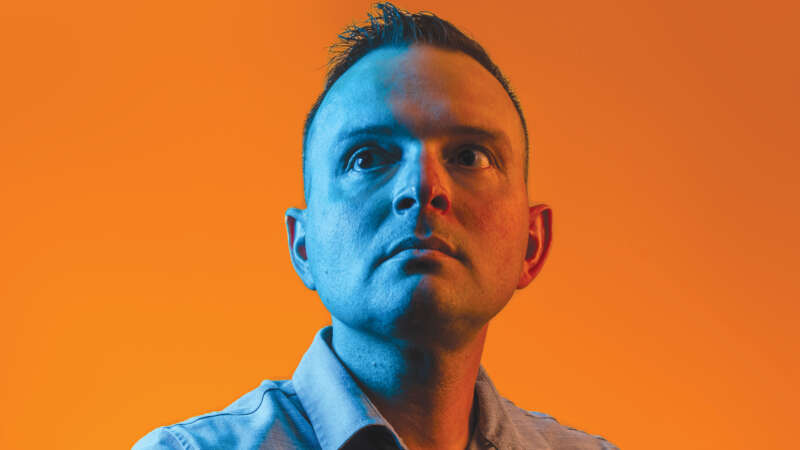
Meng Zhang
Associate professor, Industrial and Manufacturing Systems Engineering
Can 3D printers eliminate the organ transplant waiting list? This proactive professor is training tomorrow’s medical manufacturers.
Imagine sitting in a cardiology exam room, anxiously awaiting test results. The doctor enters, ready to discuss your diagnosis. But instead of pointing to a hard-to-decipher scan on a screen, you find yourself looking at a life-size, 3D replica of a heart.
Not just any heart, but your heart, which the doctor then uses to show — not tell — you the exact culprit of your symptoms.
The practice is known as 3D point-of-care additive manufacturing — a specialized field of 3D printing. While already common in dentistry where custom aligners and crowns are printed on demand and on site, it’s still considered niche for the health care industry at large.
But Meng Zhang has a vision — one in which hospitals and veterinary practices nationwide contain their own 3D printing labs to manufacture anatomical models, surgical planning tools, custom prosthetics, and even engineered tissues that could revolutionize patient care.
Unsatisfied with wishful thinking, Zhang is taking action through a multi-institutional, multidisciplinary course that prepares K-State engineering students to lead the charge.
Crucial connections
The labs that Zhang envisions are forward-thinking and unconventional, so why would the technicians who run them have a background that’s anything less? As engineers and medical specialists innovate side-by-side, cross-training becomes essential.
“Medical doctors receive training with cells and anatomy, while the engineers are trained in digital design and fabrication,” Zhang said. “In point-of-care additive manufacturing, engineers understand how to produce a 3D-printed product, but they must also understand the need — and the data — from the health care practitioners. Professional communication training forms the bridge between the two languages.”
It’s a tall order, so for his IMSE 664: Additive Manufacturing class lectures, Zhang is joined by faculty experts in manufacturing, tissue engineering, sociology, and pulmonology from several partner institutions: Wake Forest Institute for Regenerative Medicine, Texas Tech University and Texas Tech University Health Science Center. The National Science Foundation has stepped in as well with collaborative grants of more than $690,000.
Students meet three times per week: twice in the classroom and once in the additive manufacturing teaching lab, where they work in small groups to solve a challenge, like printing scans of feet for custom orthotic shoe insoles.
“I enjoy watching the students apply engineering and design-type thinking to a nontraditional problem to create an actual, variable solution,” Zhang said. “The true novelty of this project is that it builds a special combination of skill, creativity and confidence that our graduates can use in nearly any professional setting,”
Printing out potential
For industries that manufacture a high volume of standardized products, additive manufacturing doesn’t make much sense economically at this moment. In health care, though, there’s a significant — and growing — demand for individualized solutions. Knee replacements aren’t exactly a one-size-fits-all scenario, after all.
Today, point-of-contact additive manufacturing gives us more personalized medical and dental solutions that lead to improved patient outcomes, not to mention faster service, lower costs and fewer communication hurdles. But Zhang is certain it’s about to play an even more significant role.
“Ten years from now, the ultimate goal would be for scientists to create a fully functional organ,” he said. “Additive manufacturing enables a seamless connection between the digital and the physical worlds, and with the development of advanced biomaterials and printing techniques, I believe it’s possible.”