Do squirrels actually remember where they bury those acorns? Your questions answered in our squirrel expert Q&A
Squirrels. They were here on the K-State campus long before you arrived, and they’ll be here long after you’re gone, burying their treasures and happily going about their busy squirrel lives.
They’re such a common sight among our trees and buildings that it’s easy to take these complex and intriguing creatures for granted. But we are an institute of higher learning, after all, so we asked resident squirrel expert Drew Ricketts, associate professor in the Department of Horticulture and Natural Resources and an extension specialist in wildlife management and control, to tell us a little more about them.
How many species of squirrel do we have on and around the K-State campus?
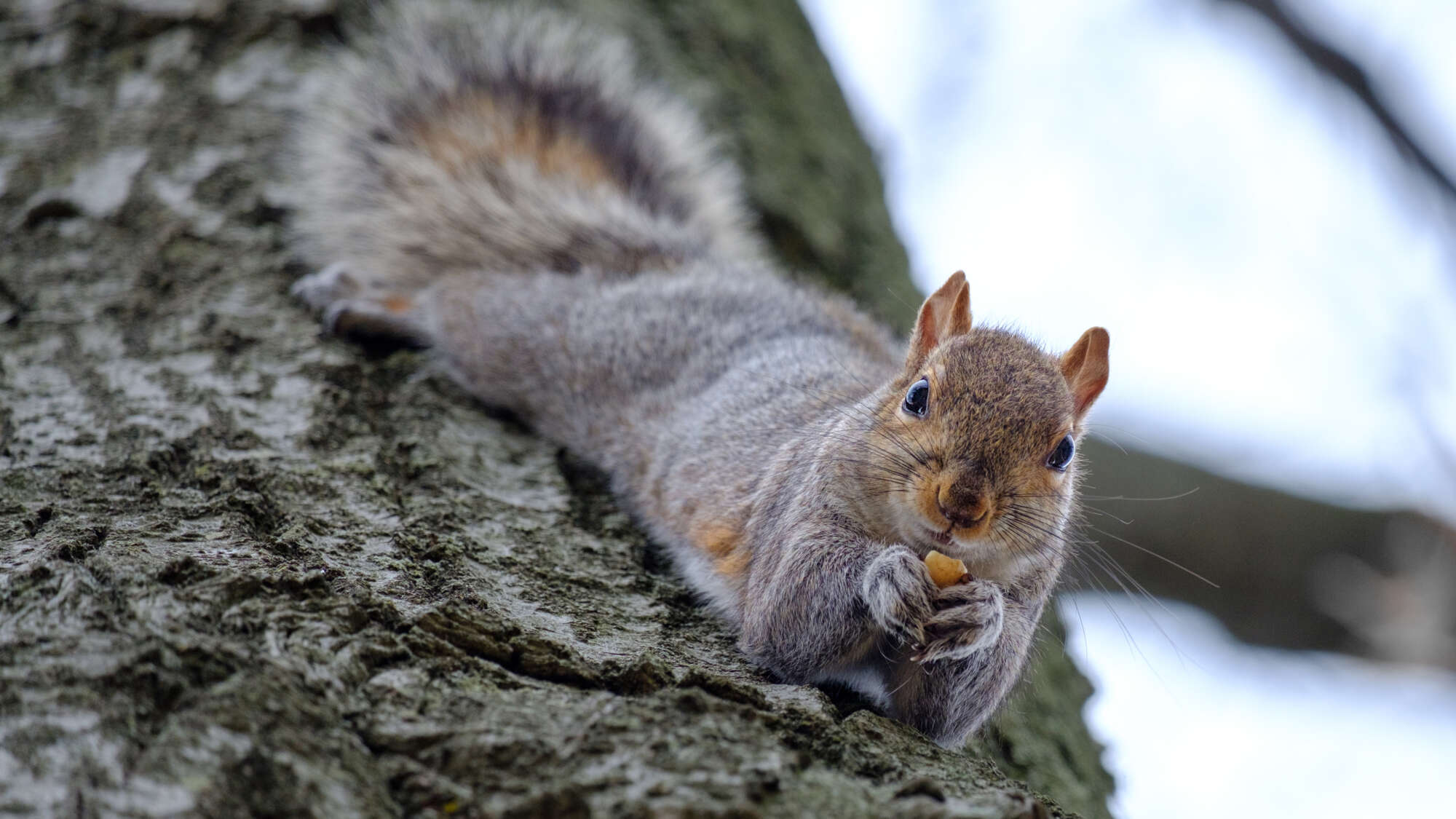
In Kansas, we have fox squirrels, which are the red ones, and there are also eastern gray squirrels. Gray squirrels tend to be more common where you have lots of eastern deciduous forests, and fox squirrels are more common further west.
The K-State campus is the only place this far west and north that I’ve ever seen a gray squirrel, and that was by the Campus Creek area on the east side of campus where I walk my dog. Otherwise, a line from Lawrence to Arkansas City is the western edge of their territory to the best of my knowledge.
In this part of Kansas we also have southern flying squirrels, though they’re nocturnal and hard to track. K-State is studying this species with funding from the Kansas Department of Wildlife and Parks, and has documented a much larger range in Kansas than was previously known.
Squirrels are rodents, correct?
Yes, rodents with fluffy tails. You know, a beaver is a rodent. Muskrats are rodents. Groundhogs are rodents. There are lots of rodents that people think of as being cute.
Why are they so common on campus?
It’s a combination of having tree species that provide good food and shelter and becoming comfortable around people. Where they adapt to humans, they can become really abundant.
We also don’t have a lot of predators around campus — towns in general tend to be refuges for many different species. As they realize we’re not a threat to them over time, they grow in number and become less reactive to us when we walk by.
What predators are they escaping from?
Coyotes eat a lot of squirrels. Bobcats, too. Hawks are also predators, and owls probably get a few right around sunrise and sunset. But when we think about towns being a refuge for squirrels, the same is true for squirrel predators like red foxes, who also want to avoid the coyotes.
While there are coyotes and bobcats in Manhattan, they’re not nearly as numerous as they would be or as bold and willing to come out and hunt during the daytime as in more rural settings.
Besides tree nuts, what do squirrels eat?
They eat a lot of seeds. In late winter, they’re digging up bulbs around campus and in the K-State Gardens. They also eat other things that grow on trees, like leaf and flower buds on elm trees, maple trees and a few others. During winter they may eat bark, sometimes damaging trees. Their natural diet is plant based, but they also eat bugs and on rare occasions, an egg or two.
They love hedge apples, and the cool thing about that is they’re going after the seeds inside them. They kind of look like a pumpkin seed. That’s why you’ll find piles of shredded hedge apples.
Do they actually remember where they bury their finds?
They have a very, very good spatial memory. There’s been a fair bit of research on that. They do remember where most of their seeds are cached.
How do squirrels benefit the campus, and where can they become problematic?
They have a great memory, but sometimes squirrels do forget about some of the nuts and seeds they bury in the ground. In doing this, they disperse a lot of seeds and end up planting trees for us.
They also simply play a valuable role in the ecosystem as prey for different species, which may not be immediately obvious as a benefit to humans, but everything is connected.
Digging for bulbs is one of the ways they cause trouble, but they can also damage buildings. Anytime you have trees close to buildings, it creates an avenue for the squirrels to get in — they’re really good at squeezing through gaps and chewing through rotten wood. Once inside, they sometimes chew on and expose wires, which is a fire hazard.
How does squirrel life change from season to season?
In late spring, they’re mating and will start very actively collecting nesting material and other resources. They stuff it into gutters and other places where they might want to create a nest. Soon, they’ll have their young. The females will nurse them, and once they’re weaned, they’re probably out on their own like most rodents.
Summertime is a good time to be a squirrel — there’s lots of food around. They’re all out and about that time of year.
And then during the late summer and fall, we start to see the younger ones that are now adults scattering and finding new places.
What’s your advice for K-Staters when it comes to interacting with squirrels?
With wildlife, you always want to give them space. Even with squirrels that are used to being around people on campus, close enough to reach out and touch one is too close. As long as you don’t corner a squirrel, it’s going to move away from you.
That is, unless you’re my wife, who was in her yard one day and noticed a bunch of squirrels chasing each other. They suddenly veered toward her and ended up basically running over the top of her. So it is possible to be stampeded by a herd of gray squirrels.
And for those who ignore your advice, do squirrels carry rabies?
We don’t see a lot of rabies in rodents. It’s more common in carnivorous species and species that a carnivore might interact with when it’s rabid. That’s why we see rabies in horses and livestock sometimes — there might be a rabid skunk in the farmyard that bites a cow, and the cow is up with rabies. Or pets that interact with the skunk.
The more you know
It’s no secret that the squirrels own this campus. They’re just letting us use it.
Share your newfound knowledge with other squirrel lovers in your life!