K-State Ph.D. student is leading the mission to recover and identify MIA WWII service members
In the winter of 1944, an American B-29 was rammed by Japanese aircraft during a bombing raid. The B-29 exploded, separating the cockpit from the tail and rendering the crew unconscious. Only two soldiers were able to deploy their parachutes.
It’s stories like these — mysteries of MIA soldiers — that drive the work of K-State history students like D.J. Schaefer. He is the founder of K-State’s MIA Recovery and Identification Project.
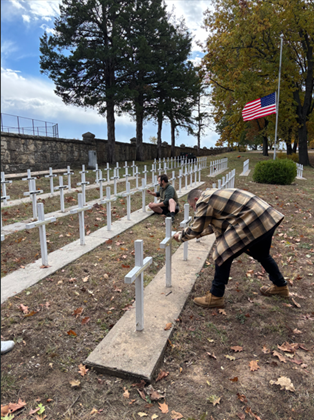
“The most meaningful part of this project is bringing closure to the soldier’s loved ones after over 80 years,” he said. “It was also very rewarding to scrub gravestones and place flags for KIA and veteran military service members for Veterans Day.”
Man on a mission
After years of wearing many unique hats – being an infantryman in the U.S. Army with the 101st Airborne Division, a commercial fisherman on the Galilee Sea and a dairy farm manager – Schaefer landed at K-State to fulfill his passion for history.
During Schaefer’s undergraduate studies at the University of Wisconsin-Madison, he recovered the crew of an MIA B-29 Superfortress aircraft. Then, while working on his master’s degree in maritime archaeology at East Carolina University, he located the remnants of a downed F6F Hellcat aircraft off the coast of Saipan.
Now at K-State, Schaefer mentors 18 volunteer researchers in historical and archival research toward MIA identification and recovery.
“Many of the volunteers are veterans, and the research and recovery efforts serve as a source of therapy for them,” he said. “It gives them a military mission to work toward and helps them to stay true to their oath, never leave a fallen comrade behind.”
Recovering process
Volunteers start with extensive research to determine the possible location of the MIA service members. They consult archives, mapping imagery overlays, deceased personnel reports, dental records and other sources.
If an MIA service member is located, they send a team to conduct archaeological fieldwork for weeks on end through all types of weather.
Once the remains are recovered, they do DNA analysis to identify the person through their surviving family. Then the remains are transported back to the U.S. for a proper burial.
K-State made this project possible with its Military Affiliated Resource Center, Institute for Military History and extensive library and archival resources.
More to do
But the work is far from over. There are still many MIA service members waiting to be located and recovered. Thanks to efforts like Schaefer’s, families are finally gaining closure and fallen service members are receiving the honor of a proper burial.
By Kate Ellwood