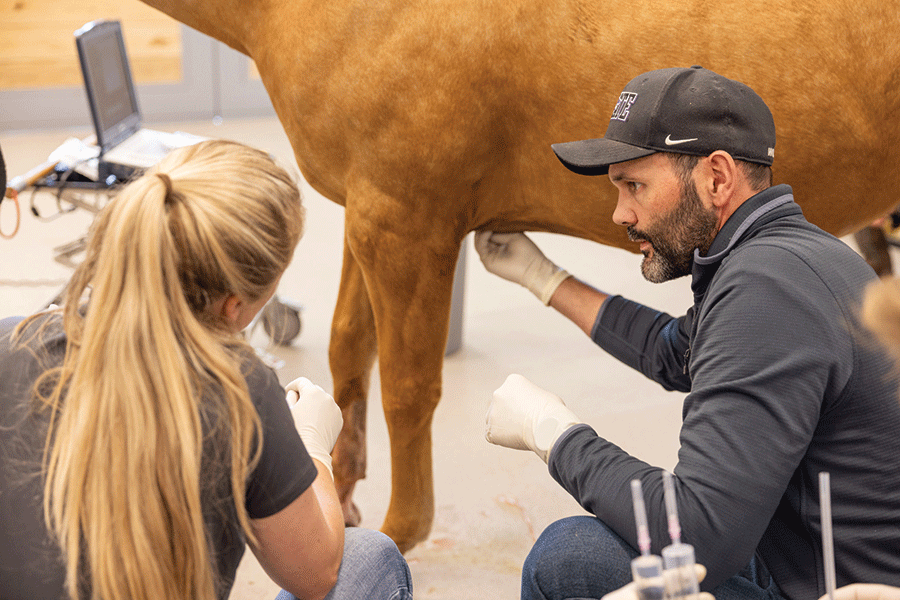
K-State’s state-of-the-art Equine Performance Testing Center is healing injured horses while giving students unparalleled hands-on experience
After her horse, Beau, tore his deep digital flexor tendon and check ligament, Nebraska horse owner Cindy Togstad brought him to the K-State for evaluation.
“It happened to be one of the worst tears I’ve ever seen in that particular structure,” said Dr. Dylan Lutter, K-State equine surgeon and clinical assistant professor. “So we turned right away to Cindy and told her that it was not good news, and that it would be a long road ahead to even get Beau back to where he could comfortably walk.”
After numerous stem cell transplants, bone marrow injections and lengthy rehabilitation programs, Beau’s health has improved.
“Even though Beau isn’t able to return to 100%, and that tendon still has a slight defect, I really think it’s important to consider how much of a success story Beau is,” Lutter said. “Without all the therapies we used to treat him, many people would have chosen to euthanize him, as he would have been chronically in pain and unable to even be turned out.”
The new addition
Before the Veterinary Health Center’s construction of the Equine Performance Testing Center, K-State would not have had the facilities to treat horses like Beau. Now, as word of the center’s expanded capabilities has spread, horse owners routinely turn to K-State for care.
The facility houses an indoor riding arena with both hard and soft footing. It is specially designed to evaluate and diagnose equine lameness or performance-limiting issues.
The new addition also includes an indoor examination area, radiographs and ultrasound imaging areas, a farrier space and a client consultation room. Combined with Lutter’s expertise in equine physical therapy, rehabilitation and chiropractic, K-State’s equine caseload has increased a whopping 48%.
Educational improvements
During the fall semester, an equine podiatry class gives students a dedicated space to practice and learn about horse-hoof health and many other things.
“When we moved the class to the EPTC, it really gave us a calm environment where students could work with horses one-on-one, improving their horsemanship and handling skills,” Lutter said. “It also allowed us as instructors to move from horse to horse and provide feedback without the distractions of a veterinary hospital environment such as a truck driving by or a barking dog that might startle the horse, which is what happened when we used to work in Mosier Hall.”
The new Equine Performance Testing Center has helped K-State make leaps and bounds toward more comprehensive treatment for horses and education for students.
By Kate Ellwood
Curated from The Equine Performance Testing Center provides opportunities for advanced healing and paves the path for expansion