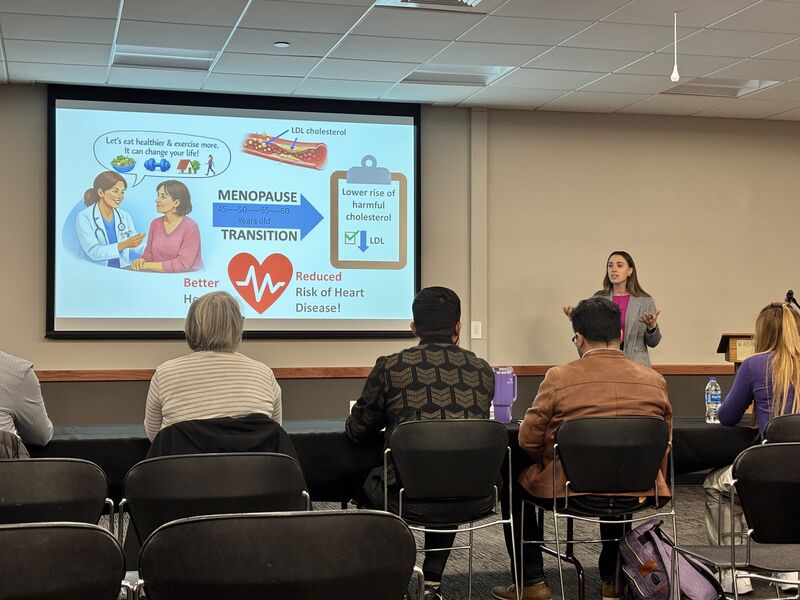
New research from K-State sheds light on how menopause affects heart health — and what women and physicians can do about it.
During her deep dive into cardiovascular research, K-State graduate student Sarah Fenn discovered a huge gap in female-specific research. Just like any other researcher, she was looking for an unanswered question. She certainly found one:
How can we improve cardiovascular health for women as they age — specifically surrounding menopause?
“It’s really an under-explored area, which is crazy to me because, as women, we all go through menopause,” Fenn said. “So it is important that we be aware of what’s happening so we can improve our quality of life and take control of our health.”
Cardiovascular connections
When women go through menopause, their ability to reproduce ends, along with a significant decrease in estrogen, a hormone with cardio-protective attributes. These shifts in hormone levels on top of normal aging contribute to the increase in blood pressure, cholesterol and body weight that occurs in the years surrounding menopause, causing strains on the heart.
The investigation
Fenn and her team used information from the National Health and Nutrition Examination Survey, and another national survey of women’s health. They gathered their findings to produce a paper specifically for physicians.
“We wanted to make sure a physician reading our research would be able to immediately apply the findings to patient treatment,” Fenn said. “We wanted it to be actionable because this world moves fast.”
Discoveries
Since menopausal symptoms vary so drastically among women — hot flashes, joint pain, mood shifts and more — Fenn found that a more functional approach was appropriate.
“Menopause is such an individual experience even though it’s experienced by all women,” she said. “That’s why lifestyle advice has shown to be the best medicine for both improving severity of menopausal symptoms and decreasing heart-disease risk.”
Advice such as improving diet, increasing physical activity and managing stress help to battle menopausal symptoms and cardiovascular attackers.
“We found that women who received lifestyle advice from their physicians had improved cardiovascular health trajectories through and after menopause,” Fenn said. “They experienced a smaller increase in LDL cholesterol, a particle that is known to clog arteries.”
Through K-State, Fenn presented the topic at the 3-minute thesis event, which gave her inspiration for spreading the word. She says she hopes to see positive ripples created by her work.
“Hopefully our research sparks a conversation not only between physicians but also between women,” she said. “It’s crazy that a simple conversation can so positively help someone’s overall health.”
By Kate Ellwood