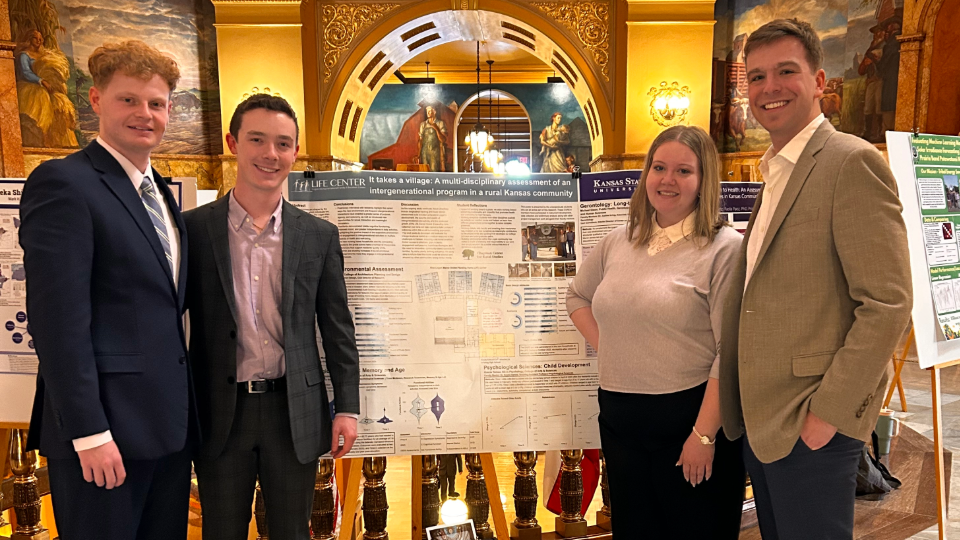
An innovative community model in Logan is reshaping rural living, and K-State students are documenting its impact.
Rural Kansas towns continue to shrink year by year as younger generations move to urban areas for education and job opportunities.
This can increase social isolation and lack of community, leaving behind the elderly and cutting many chances for children’s social development.
To tackle these issues small towns must get creative to battle back against these issues. In Logan, Kansas, the new Logan Intergenerational Family Education Center, or LIFE Center. Its clever combination of a 36-bed nursing home, elementary school and community spaces is connecting families and neighbors in beneficial ways.
K-State involvement
K-State launched a research project to explore the benefits of the LIFE Center, engaging four undergraduate students — Madison Cynova, Carter Oliver, Gracie Toman and Michael Glenn — through funding provided by the Chapman Scholars program.
Each student, guided by a faculty mentor, focused on a different area — memory and age, interior design, long-term care, childhood development — and collected data through resident and elementary student surveys.
Showtime
After all the information was gathered, they used the promising results to create their presentations. The pressure was on because their first showcase opportunity was in front of a very intimidating audience — state legislators.
At the Kansas State Capitol, the students presented the LIFE Center research to interested legislators and answered questions about their specific focus area.
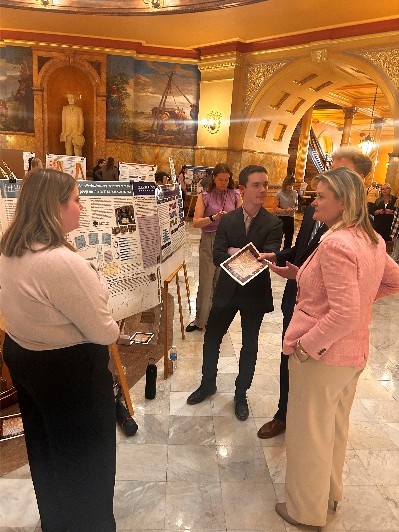
“Our main mission at the Capitol was to share how the new model of long-term care can benefit rural Kansans and help older adults in areas where it is difficult to find care,” Glenn said. “I think we did a good job of conveying that to legislators.”
The students explained how the LIFE Center’s design and programs enhance social connectivity leading to improvements in the cognitive function and emotional well-being of both seniors and children. Their conversations with legislators were enhanced by displays highlighting quotes from Logan residents, informational graphs and photos of the new facility.
“It was really great to see the bipartisan interest legislators had in our project,” Oliver said. “Both parties were interested in rural Kansas education and what our project was doing to aid small communities.”
The undergraduates continued to share the impact of the LIFE Center with additional conference presentations after the kickoff at the Capitol. The students were grateful for the nerve-wracking opportunity to present to legislators, reflecting that the following demonstrations seemed much easier.
Gratitude
Throughout the project, the undergraduates had a lot of valuable interaction with Logan community members, business officials, team members and interdisciplinary faculty across K-State.
“It’s been incredible to work on a team where every member was purposefully motivated to work hard,” Toman said. “We learned how an interdisciplinary team functions, and I think it’s something that allows me stand out as a student and a future employee.”
With two more years for the LIFE Center research project, new students will be stepping in as some of the originals move on to their next chapter.
“I love this project. It has been one of the most shaping experiences I’ve had as an undergraduate,” Toman said. “There are a lot of potential benefits of the initiative, and I know it will gain a lot of interest in the coming years as people learn more about what the LIFE Center is accomplishing.”
By Kate Ellwood