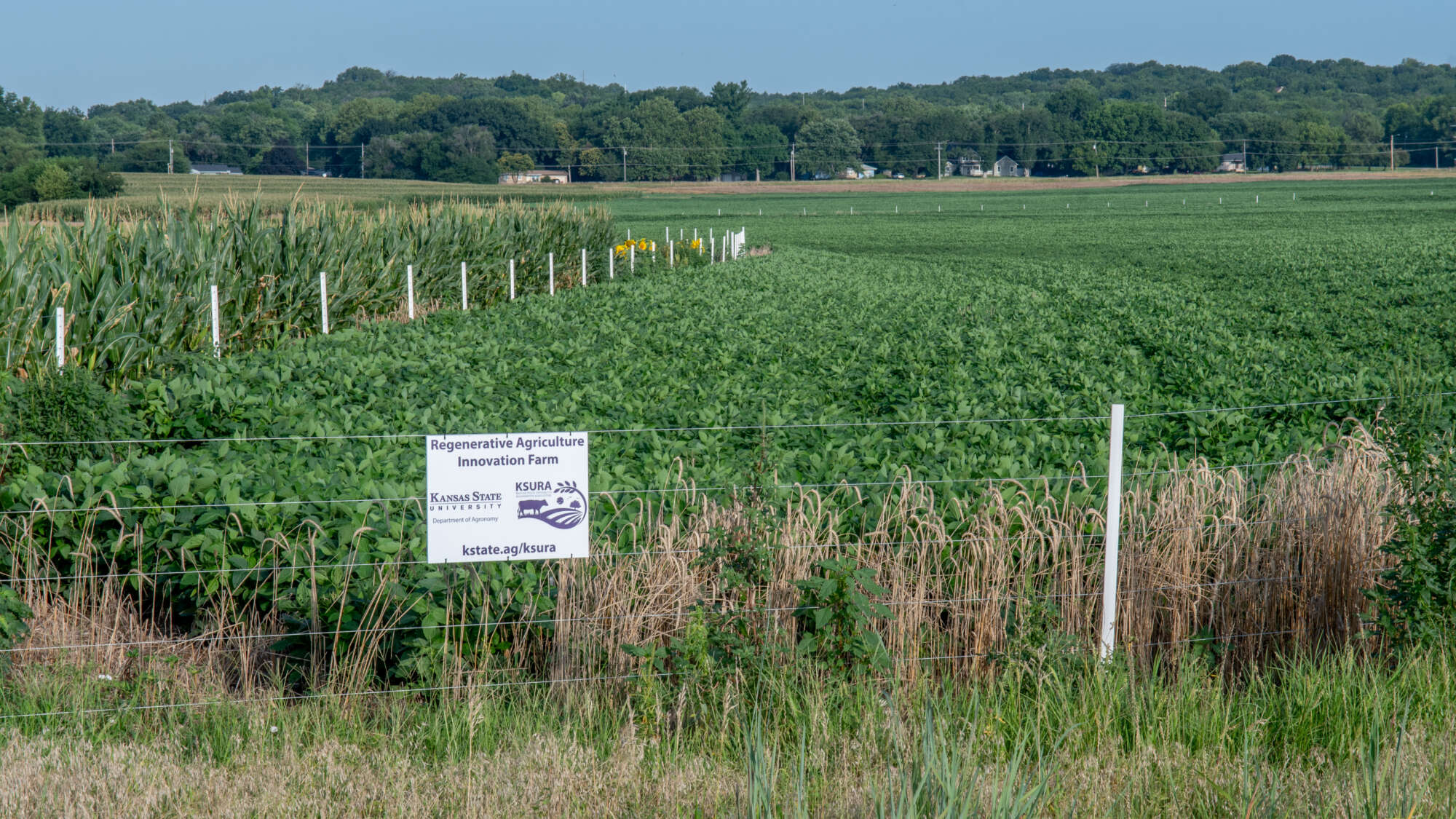
An interdisciplinary team of K-State faculty launches a model farm to test the viability of regenerative agriculture
By 2050, the world’s population will exceed nine billion. That’s nine billion hungry mouths that will rely on farmers to supply a safe, stable food system.
With the increasing population, farmers must increase their crop yield and overall production numbers. To do this, some changes need to be made.
Regenerative agriculture is a new tactic that works to sustain natural resources for future generations while generating a profit and feeding the world.
What is regenerative ag?
Taking care of the soil, water and air is central to most farmers. Regenerative ag seeks to restore the health of ecosystems through natural processes like carbon sequestration, water retention, pest and disease control, livestock grazing and especially analyzing soil biology.
The goal is to achieve circular bioeconomy where there is zero waste and nothing put into the land leaves it.
“Regenerative agriculture offers a sustainable solution to many environmental and social problems facing our world today,” said Chuck Rice, a university distinguished professor in agronomy. “(At K-State), we believe that regenerative agriculture can transform agriculture into a more sustainable, profitable and resilient system.”
Game Changing Research Program (GRIP)
To encourage K-State experts to form interdisciplinary teams, K-State’s Office of Research created GRIP to fund faculty teams ready to study grand global challenges facing our people, society and the planet.
Rice was a member of the team awarded GRIP funds, which encouraged him to unite researchers with expertise in areas from soil health to corporate marketing and biology.
Rice and his team plan to establish a regenerative agriculture model farm on the university’s North Farm to test strategies such as cover crops, fallow, livestock grazing and more.
Six principles of regenerative agriculture
The team will be using the model farm to figure out the viability of the following management techniques:
- Minimal tillage
- Keeping residue in the soil
- Maintaining a living root
- Crop diversity (cover crops and crop rotations)
- Integrating livestock
- Considerations of people, time, soil properties and climate
Tracking the results
K-State agricultural and biological engineer Trisha Moore will lead efforts to analyze the environmental impacts of the model farm like greenhouse gas emissions.
Assistant professor of precision agriculture at K-State Gaurav Jha said the farm will include sensors in every field to gather data on precipitation, soil moisture, temperature and nutrient levels. He also plans to employ drones, robotics, satellites and crop breeding.
Global attention
Food companies like McDonald’s, PepsiCo, Costco, Nestle and others are closely watching K-State’s regenerative ag efforts as they consider the increasing demand in the food market.
Younger generations are becoming more attentive to how their products are being made and tend to show more support to “greener” beginnings.
As people consider the future of food, K-State’s regenerative ag program has the world’s unwavering attention and increasing support.
By Kate Ellwood
Curated from K-State launches model farm to study regenerative agriculture practices