Shrubs. Mice. Lyme disease? A K-State student explores how increased wooded areas on Konza Prairie affect mice populations — and human health.
As Konza Prairie sees an increase in wooded and shrubby areas, it also experiences an influx of white-footed mice — rodents that can spread disease to humans.
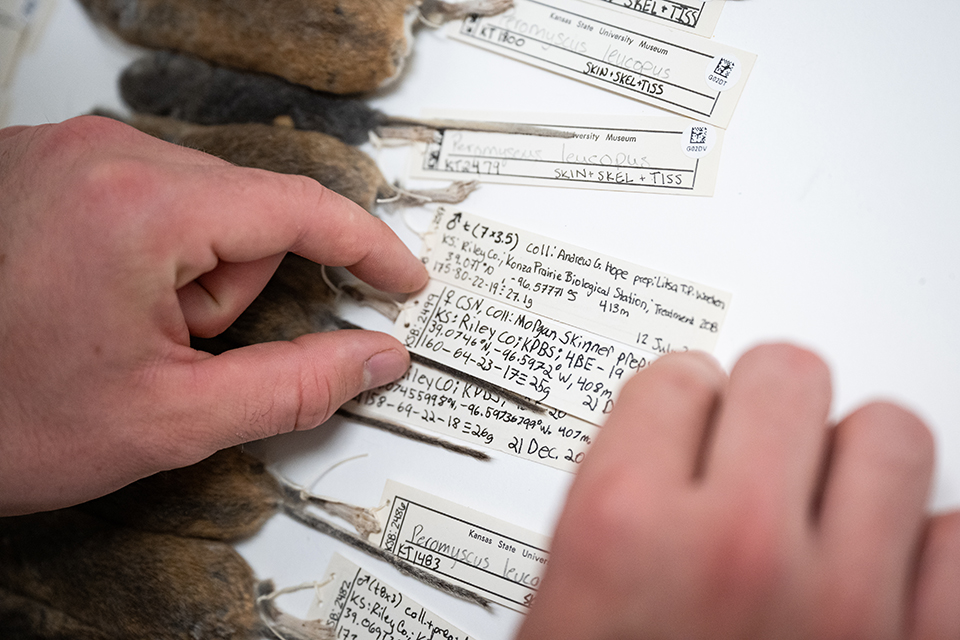
Sam Speck, a K-State senior in conservation biology, is leading an undergraduate research team that tracks long-term changes in the types of mice found around the tallgrass prairie preserve.
“In the field, we were starting to see way more of the white-footed mouse, and that wasn’t the case even 10 years ago, when the deer mouse was still more abundant,” Speck said.
The white-footed mouse thrives in wooded or shrubby areas, while the deer mouse prefers to reside in prairie grassland environments. Research shows Konza Prairie gains more wooded and shrubby areas when it has not been burned as frequently.
Interspecies effects
“With the shift from deer to white-footed mice comes increases in zoonotic disease risks for humans,” Speck said. “The white-footed mouse can carry many kinds of diseases that can then be transmitted to humans. As densities of both mice and ticks become more abundant in woodland areas, so does the potential for disease.”
White-footed mice are known to carry ticks with Lyme disease — Kansas has more reported cases of Lyme disease every year. This isn’t just an issue for Konza Prairie. Similar mouse population shifts have been observed across Kansas, particularly in areas with minimal prairie burning.
“We take mice for granted, mainly because they’re so abundant everywhere,” Speck said. “But because of that, they’re an excellent way to study the underlying ecological mechanisms in an environment. It’s kind of cool that this one little mouse can tell you so much about what’s going on in the broader scheme of nature.”
Due to his research, Speck’s passion for parasitology has a great chance at making a real difference in the world.
“I want to do research that impacts people in a way that matters,” Speck said. “Parasitology is a field where I think I could do that. Here in the U.S., we don’t feel the effects of parasites as much, but around the world, millions of people suffer from them. I’d love to work in that field and maybe even one day come back to K-State as a professor.”
Speck’s work has caught the attention of many, including the journal BioScience, and he attributes his success to his education at K-State.
“K-State is uniquely situated to provide hands-on research experiences because it prioritizes faculty who are invested in connecting students to career-building opportunities,” he said. “I’ve had so many of those here, and it’s helped me build a resume that’s going to set me apart as I pursue my dream.”
By Kate Ellwood