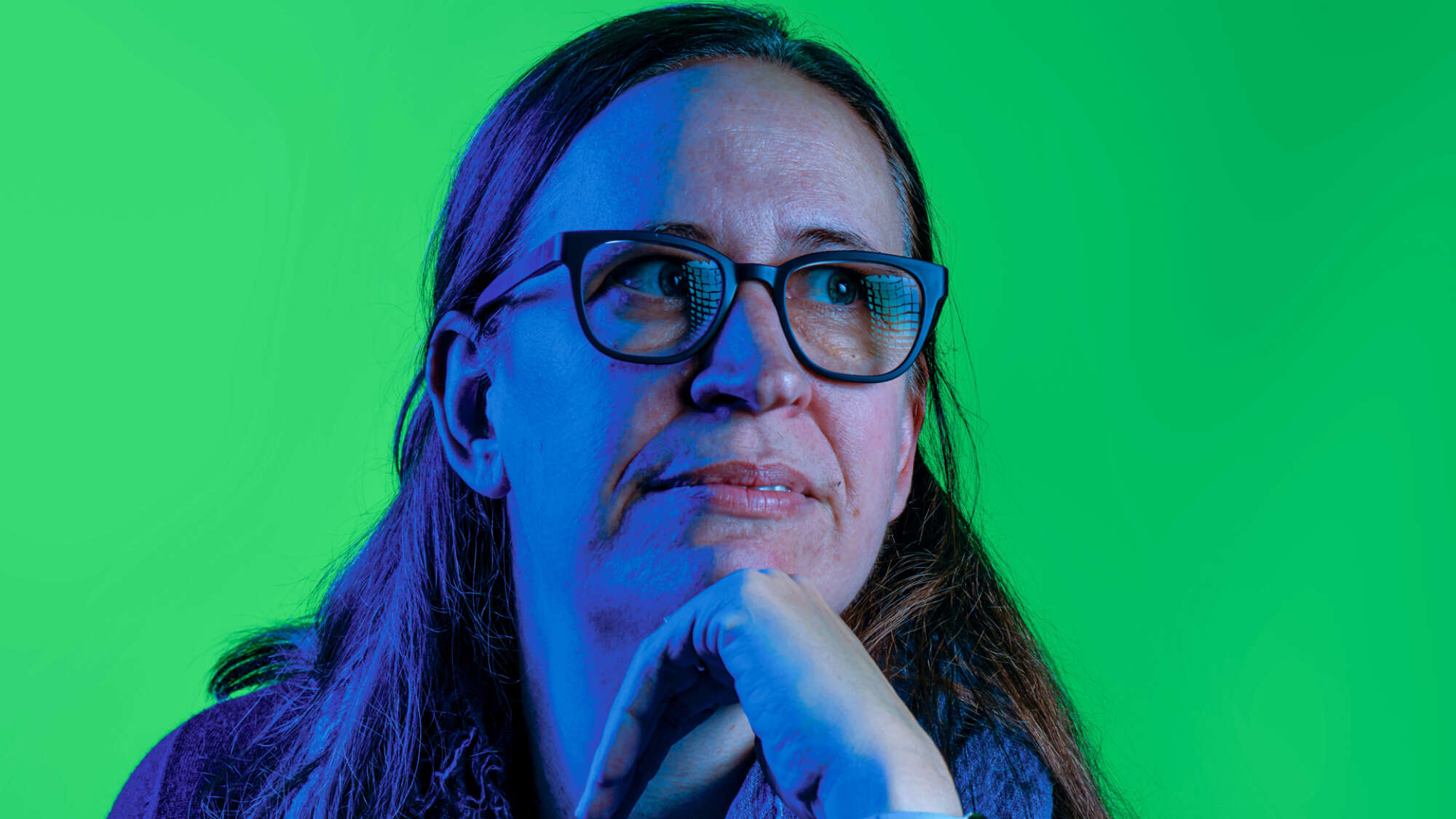
Kendra Kirchmer
Associate professor of interior architecture and furniture design
Studio professor of Vital Design Studio
When it comes to your health, what’s more important: your genetic code or your zip code?
Can a designer keep you from having a heart attack?
Kendra Kirchmer certainly thinks so. She didn’t go to medical school, but that’s not stopping her from improving people’s health outcomes.
In 2021, she created Vital Design Studio, an interdisciplinary program that teaches future designers to create spaces with an eye on improving health outcomes.
“Designers have a key role in how built environments can make people’s lives healthier — and longer,” said Kirchmer. “Socioeconomic factors, healthy behaviors and physical spaces, otherwise known as upstream considerations, have a big impact on a person’s health. The distance of just a few city blocks can mean a huge difference in a person’s life expectancy.”
Laying the groundwork
Ironically, it was the global pandemic that prompted Kirchmer to develop the Vital Design Studio.
“Student internships were not possible because of COVID,” Kirchmer said. “As a replacement, I developed a seminar to expand the idea of what it means to be healthy and how design can impact a person’s health.”
Knowing that hands-on experience was essential for her students, Kirchmer grew the class into the design studio with the involvement of Philadelphia-based architect and K-State alum Louis A. Meilink, Jr., and his wife, Janetann.
“Lou was — and is — enthusiastic about the intersection of population health and the built environment,” said Kirchmer. “His expertise, passion and investment have been critical to the studio’s success.”
As in the real world, K-Staters work in small teams that include at least one student from architecture, interior architecture and landscape architecture programs.
“Architects and designers with different specialties routinely collaborate to address all of the needs of a project,” Kirchmer said. “They learn from each other, creating a level of respect for the expertise they each bring to the table.”
Building cities of the future
Studio research kicks off each fall when students visit Philadelphia’s real-world locations and connect with community members. They also learn directly from Meilink and other designers at his firm. When the students return to campus, the work really begins. And their inventiveness is allowed to run free.
Student projects have ranged from a culinary school that doubles as a soup kitchen and job creator to a laundromat equipped with a mobile health clinic, public showers and outdoor green space for recreation.
Their designs tackle a variety of societal and health issues: housing affordability, food deserts, childcare availability, the opioid crisis and beyond.
Unrestrained by a budget, it’s blue-sky thinking at its best. “The scope of their project is only limited by their imagination,” said Kirchmer. “The one unrealistic project feature is the lack of a budget. I don’t want to restrict their ideas and solutions with the bottom line.”
Building on her skills and experiences, Kirchmer has created a space for students to stretch their design creativity. Whether they go on to design community health centers or skyscrapers, they’ll have know-how to incorporate features that influence healthy behaviors and choices.
How will the built environment shape healthy lifestyles in the future? Kirchmer is optimistic that her students will push the boundaries.
“The student projects get more creative and thoughtful every year. They rethink what a library or a laundromat can be and the role it can play in the life of a community,” Kirchmer said. “Our students are learning how they can use their talents to help people, and I’m excited to see what they do in the next 10 or 20 years.”