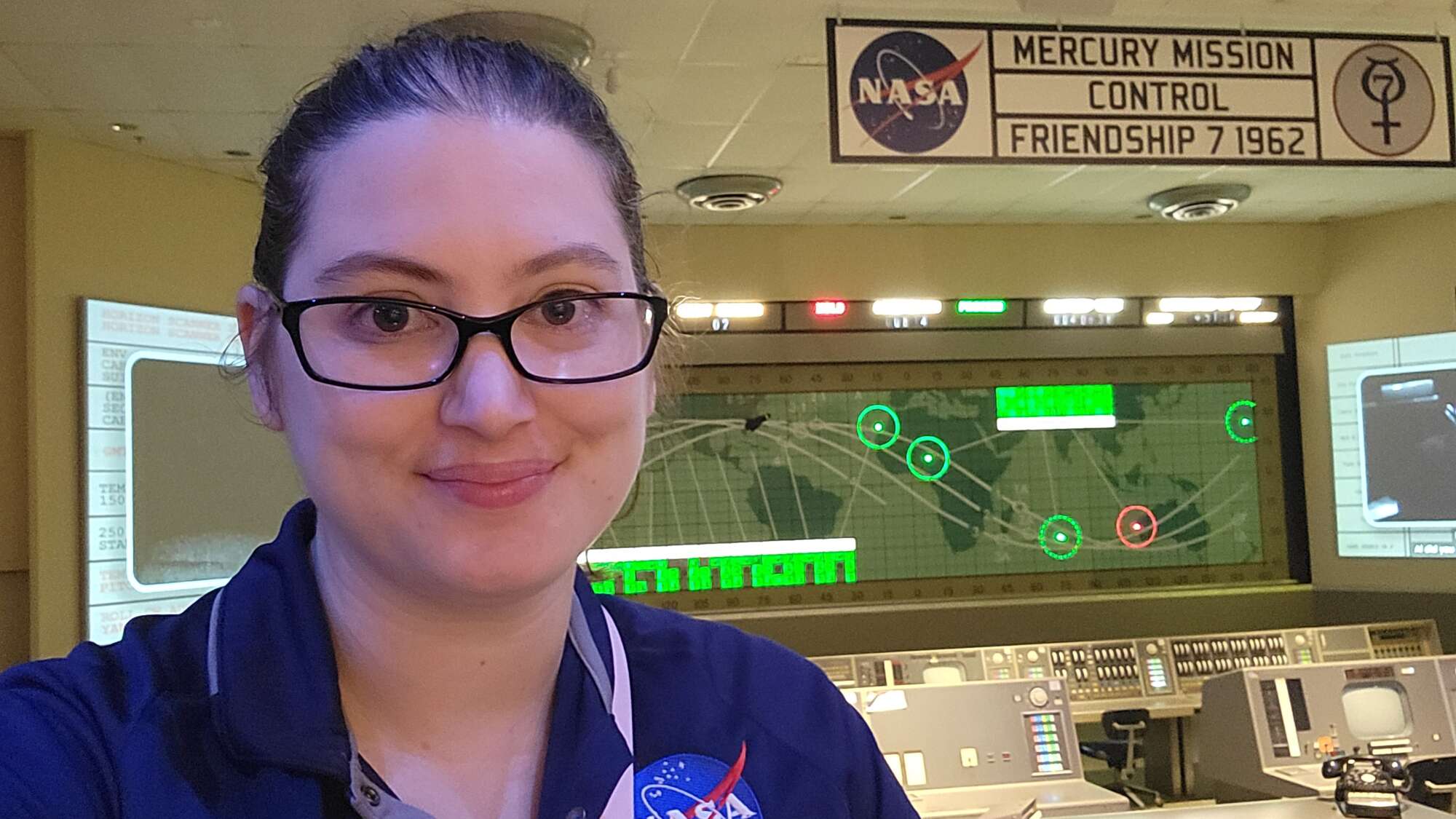
A strong foundation, supportive professors and perseverance land alum her dream job.
A love of Star Trek and a week at K-State’s EXCITE summer camp sparked Ashton Archer’s desire to reach for the stars, literally.
“I really want to be an astronaut,” Archer said. “I wanted to be a Starship captain, but Starfleet doesn’t exist. So what’s the next best thing? Being an astronaut.”
When enrolling at K-State, Archer feared she couldn’t afford the extra fees and classes required of an engineering major, so she started out in political science. But after one semester, she made the switch to mechanical engineering, taking the first step on her journey to NASA.
Laying the groundwork
Faculty don’t just teach, they mentor. As an undergrad, Archer worked in Amy Betz’s multiphase microfluidics laboratory. Betz, Alan Levin Department of Mechanical and Nuclear Engineering associate professor and assistant dean for academic success, recalls meeting this student from small-town Kansas who was a little shy about sharing her true dream.
“I asked her what she wants to do for a career, and she said she was nervous to tell me because she’d been told her dream was impossible,” Betz said. “She told me she wants to work for NASA someday, and I told her, ‘Ashton, that’s the most reasonable goal ever. You’re getting a degree in mechanical engineering. Who do you think goes to work for NASA?’”
Archer credits working in Betz’s lab as one of the ways K-State prepared her for her career, along with taking the measurements and instruments class.
“It turns out not everybody has those classes or those opportunities,” Archer said. “I think all the hands-on opportunities and all the engineering clubs — that hands-on experience — is so crucial because you can learn from books, but that doesn’t prepare you for the day-to-day. It helps bridge the gap between knowledge and experience.”
NASA bound
Today, Archer is a lead systems engineer at NASA.
“I get all the different disciplines together and make sure we’re all communicating and sharing information throughout the project life cycle of design, integration and testing,” Archer explained. “We integrated all the parts once we get past the design phase, then integration, testing and eventually delivery.”
But Archer didn’t land at NASA right out of college.
“I worked in industry and kept applying to work at NASA and I kept not getting accepted,” Archer said. “But it’s actually a good thing, because all the things I learned at the other companies made me so much better at the job I’m in today.”
Between her industry work and NASA, Archer has worked on a variety of projects, from a lunar rover to a lunar space station. She said it’s rare for someone to stay on a project through its whole life cycle, and it’s common for projects to get canceled. But one of Archer’s recent projects — a tool to remove dust from astronauts’ suits — will be used on a future Artemis mission.
“The instrument I helped make, that has my name on it, is going to the moon. I’m very excited about that,” Archer said.
Live long and prosper … then pay it forward
Every semester in Betz’s freshman design class, engineering problem solving, she gives students a hands-on assignment. This year the students wanted to do a project related to Artemis, so Betz reached out to Archer at Johnson Space Center.
“The students are going to pick their own type of probe or instrumentation they would like to design for a lunar terrain vehicle. They’ll try and meet the real Artemis mission science,” Betz said.
Even though the class will only create prototypes, the students were concerned their designs might not fit with what NASA has planned, making their experience not as realistic as hoped. As it turns out, this process is very realistic.
Archer explained to Betz that NASA doesn’t care about integration in the beginning phase of product design.
“We’re actually following their process of first design big, come up with ideas, test those ideas, and then figure out how we fit in the best ideas,” Betz said.
The students are doing the first step of the real process, whether at NASA or a NASA contractor.
“I’m really looking forward to seeing what they come up with because sometimes here in industry, we get siloed,” Archer said. “Sometimes the simplest things the students come up with are just brilliant.”
Besides the hands-on experience, Archer has some advice for the students.
“You don’t have to have a 4.0. Work hard through projects and internships and do work that you’re passionate about and find meaningful, and don’t give up when it sucks,” Archer said. “And also, you’re not going to get your dream job right out of the gate usually.”
And that advice is something Archer herself still follows.
“I’m not an astronaut yet, but I’m going to keep applying,” she said. “I want to go to the moon and find a sunny spot to look at planet Earth. That would be really nice.”