K-State professor builds knowledge graphs and improves AI trustworthiness
To the average person, a knowledge graph may look like gibberish on a spreadsheet. But for others a knowledge graph can impact the world.
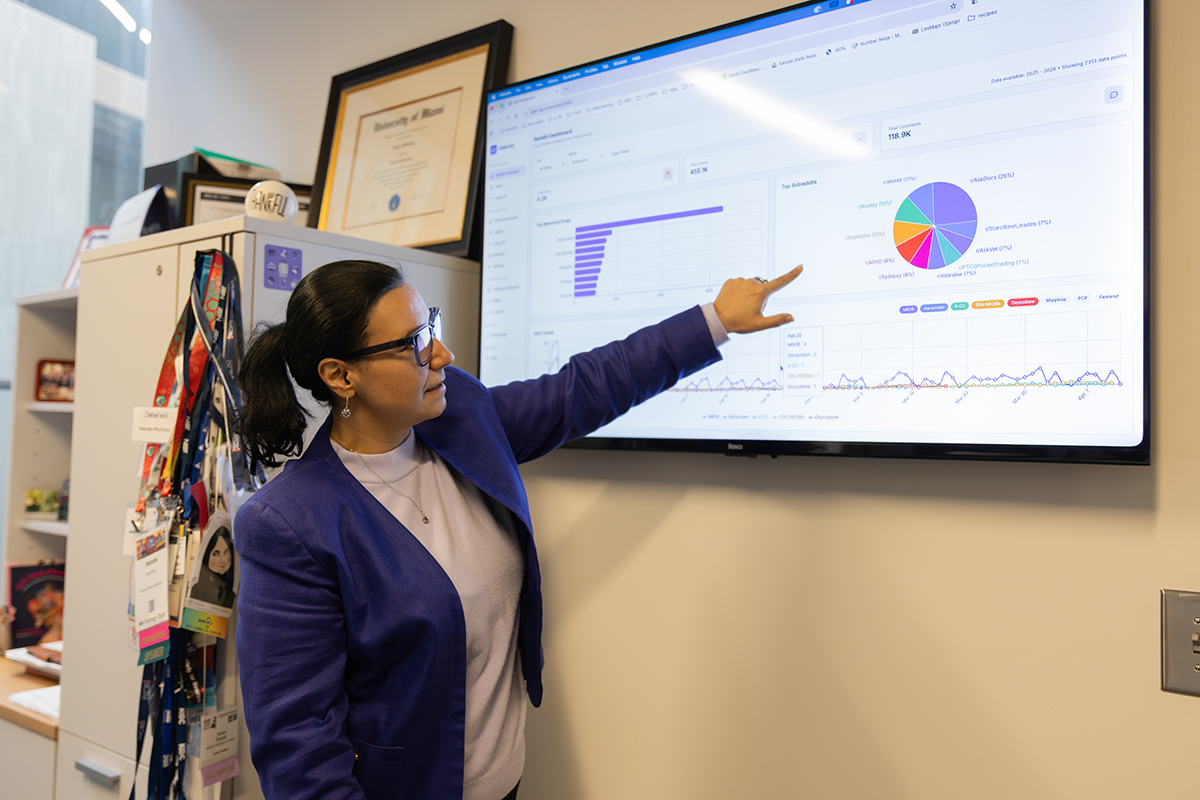
Assistant Professor of Computer Science Hande Küçük McGinty has developed knowledge graph projects that range from showing how biological aging can affect your health to helping the EPA track water contamination.
What does a knowledge graph do? Well, the human brain does it every day.
“Knowledge graphs use mathematical logic to describe all the concepts and processes that we encounter, as well as the relationships among them,” McGinty said. “We do this all the time in our heads without thinking about it.”
Knowledge graphs empower machines to connect the dots and make inferences, just as the human brain does. New data can be added to the structure to make it more valuable and trustworthy.
McGinty and her team apply their work to important efforts like helping farmers pick the best seed variation or predicting how ice crystals form on the International Space Station. Their projects impact local, national and even international communities, but the goal of building trustworthy AI remains consistent.
“We are actively improving our systems to reduce AI hallucinations and make them robust through our research. We are working with the EPA chemists and the agronomists to make sure that my data is indeed representing the truth,” she said. “It’s not just us dumping all the data on a graph.”
One way they do this is by designing a verifiable reasoner. The first-of-its-kind invention is patent pending, and it helps AI systems derive correct inferences using knowledge graphs. The verifiable reasoner will help them build more applications and connections.
McGinty’s lab is improving AI trustworthiness through knowledge graphs for the good of K-State and beyond.
By Will Hudelson
Curated from Mapping the future: K-State computer science positions Kansas for its AI era