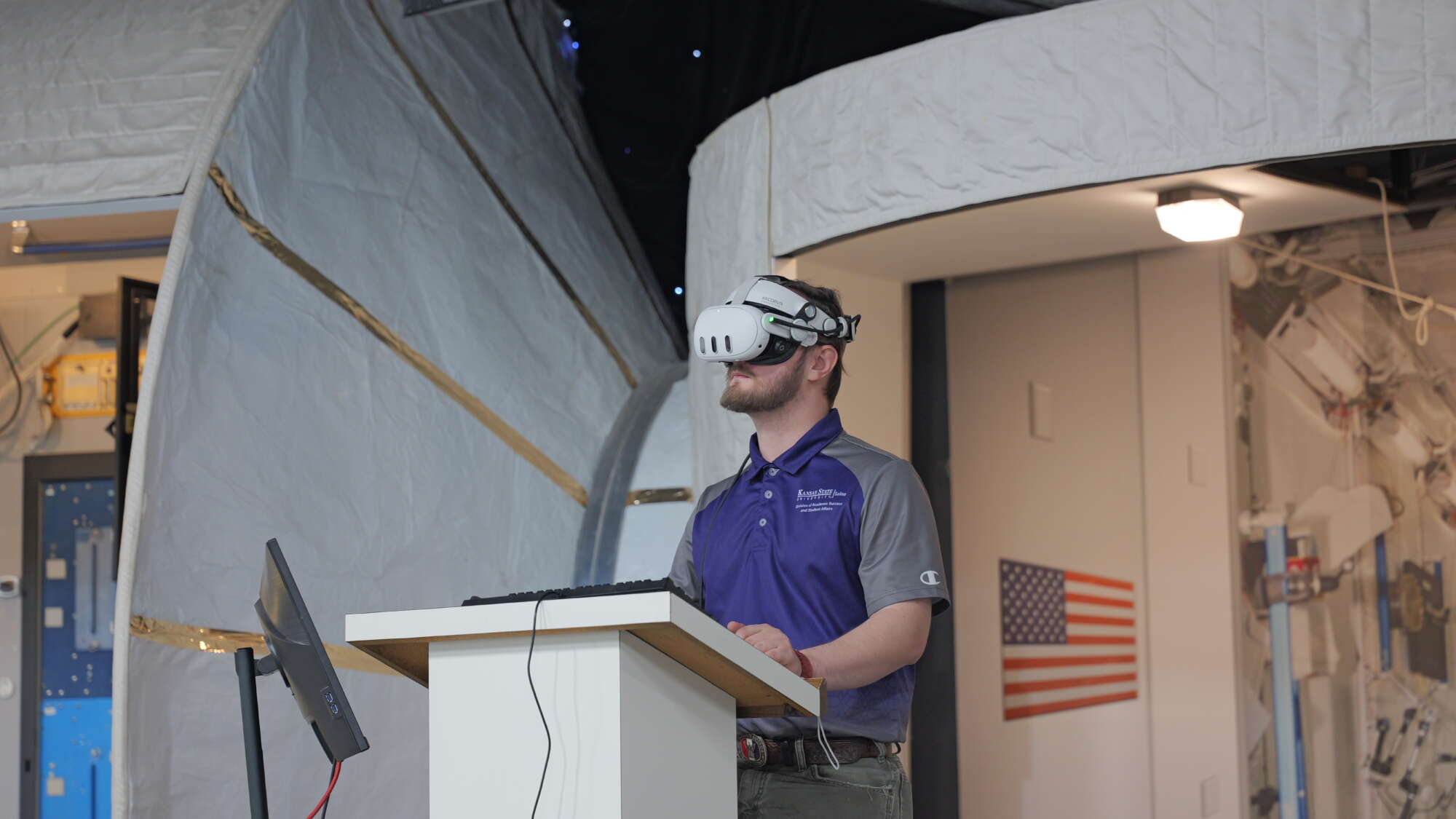
From simulation to inspiration, K-State students are creating hands-on experiences for young campers that bring space down to Earth.
K-State Salina and the Cosmosphere Science and Space Museum recently launched a partnership, inspiring the next generation of STEAM students to shoot for the stars.
The collaboration lifted off with a tour of the Cosmosphere facilities for K-State faculty. The space museum has a physical mock-up of the International Space Station used for air leak simulation activities during their Cosmo Camp. After observing the model, K-State faculty members decided to create an updated activity for campers.
“Astronauts use special sonic tools to detect air leaks in the space station,” said Michael Oetken, director of the K-AIRES Lab at K-State. “We decided to have seniors make a virtual reality simulation of the leak detection for their capstone project.”
Simulation creation
The seven seniors specializing in virtual reality design went on a visit to the Cosmosphere to attend a kickoff meeting. They met with the education team, observing the facility and taking notes.
“We have STEAM educators on staff at the Cosmosphere,” said Ector Diaz, Cosmosphere director of marketing. “They gave guidance to the students and then the project took off.”
The students did extensive research and learned about the space station’s qualities, as well as how to use Unreal Engine programming — a video game creator platform.
They used the platform to create code, animations, sound features and interaction software.
“They figured out what did and didn’t work and then presented the rough draft,” Oetken said. “They also tested the simulation on some local middle schoolers, and the feedback was extremely positive.”
The final product is used at the Cosmosphere’s summer Cosmos camp, giving campers an immersive space experience.
“The partnership with K-State helps campers figure out if they are interested in pursuing STEAM education through schools like K-State, specifically with VR programs,” Diaz said. “VR technology is a continuously growing area, with potential to be used for actual space training for astronauts.”
Blasting into the future
“The VR simulation was a great applied learning experience because it is very similar to what the students will do in the future,” Oetken said. “They practiced project and client management and learned what it’s like to finish a real project.”
This was only the first collaboration between K-State and the Cosmosphere. There are already plans for similar projects being written in the stars.
By Kate Ellwood