From Kansas farm girl to NASA engineer, Ashton Archer continues to reach for the stars
The Kansas motto — Ad Astra Per Aspera, which means “to the stars through difficulty” — could be Ashton Archer’s personal motto.
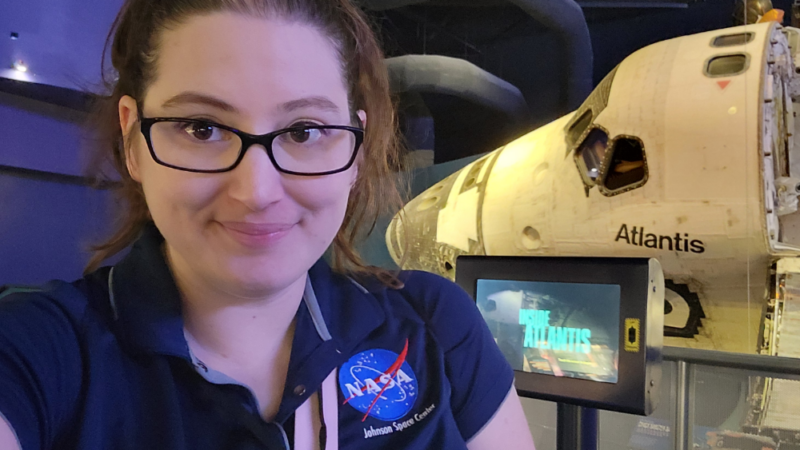
A love of Star Trek and a week at K-State’s EXCITE summer camp as a high schooler sparked her desire to become an astronaut. Archer, a 2014 graduate in mechanical engineering, is now a systems engineer for NASA based at Johnson Space Center. And while her projects have traveled to space, she hasn’t fulfilled her dream to travel to the moon — yet.
What made you want to be an astronaut?
Honestly, I think it was Star Trek. I grew up watching Star Trek: Next Generation and Star Trek: Voyager, which was probably the most influential. Captain Janeway is my favorite Star Trek character because she was a commander and also a scientist. That was really aspirational. She was confident in herself, and she could be both a leader and a scientist. There wasn’t anyone else who was that kind of role model.
An astronaut is kind of a glorified lab technician. I love lab work! Basically, you get to do science in space. And you get to teach as well, because a lot of what astronauts do is public relations. And the science experiments they do in space are for the benefit of all of us down here. It just seems very selfless and altruistic; what you’re doing is for all of humanity. That resonated with me, and it’s similar to Star Trek where they’re exploring new worlds for the good of everyone.
That was the mental parallel I made and why I wanted to be an astronaut. I want to do science that benefits others, and I want to teach.
How did K-State prepare you for your career?
Definitely working in Dr. Amy Betz’s multiphase microfluidics lab. Getting to work in her lab was incredibly meaningful and gave me so much insight I didn’t know I needed.
One example is figuring out how to integrate systems and how to work with other groups. I remember we traded skills. We needed some material deposited onto a silicon wafer. The guys over in the nuclear lab were the ones with the machines to do it. But instead of paying them, we traded skills. They wanted us to teach them how to use our milling machine. At the time it seemed like a normal thing to do, but working with other groups for a common goal was actually really helpful from a systems engineering perspective.
We also had a measurements and instruments class that was not fun, but it was vital. It’s astounding to me when I encounter people who don’t understand taking proper measurements. That’s just fundamental.
My most valuable experiences were that class and working in a lab. It turns out not everybody had those opportunities. All the engineering clubs, too: Getting that hands-on experience is so crucial because you can learn from books, but it doesn’t actually prepare you for the day-to-day. Those hands-on opportunities help you bridge that gap between knowledge and experience.
Did you take classes outside your major?
I took some random classes in college, and I think that made me a much more ethical engineer. I took a philosophy class on ethics and morals. It was a wild and weird class, but it was really helpful. I took intro to classical cultures, which was an English course, but we studied a lot of Socrates. I think it changed the way I thought about things.
I think it’s really good for engineers to take humanities classes, because we often get so focused on just the facts and physical things that we don’t think about the metaphysical, if that’s the right word.
I’m a big proponent of STEAM, not just STEM. Art is so important, and engineering is an art, in a way. Art is design and design is an important part of engineering. Having a more humanities-based background really helps with problem solving. We have some designers at Johnson Space Center who are not engineers. They think in such a different way, and it works so well when you have them on your team because they help you conceptualize things.
What exactly do you do at NASA?
I am a lead systems engineer for projects or missions. I get all the different disciplines together to make sure we’re all communicating and sharing information throughout the project life cycle, from design to integration and testing and then eventually to delivery.
I worked on a rover that was meant to go to the moon and search for water ice, but it was canceled in 2024. Then it got resurrected. We call it Schrodinger’s Rover. I worked on Gateway, a space station that was meant to go around the moon and stay in lunar orbit as a science space station. It was canceled too. I worked on a vehicle called Pressurized Rover with JAXA (Japan Aerospace Exploration Agency). And now I’m on a team making a tool for astronauts to remove dust from their suits.
I’ve worked on a variety of projects, which is really common at NASA. It’s very rare for somebody to stay on a program for its entire life cycle. And the canceling of programs is pretty common. I actually have a better success record than some of my colleagues because before I came to NASA, I worked in industry. So I’ve actually made products from start to finish.
What’s your advice for K-State students?
When I speak to students, I’ve told them some embarrassing stories because I really struggled with some of my engineering classes. There was definitely a stairwell in which I cried often. You’re under so much pressure because sometimes you think everyone is going to get the position you want, and that’s not true. Engineers are really hard on ourselves; we’re type A perfectionists.
One of the things that has stuck with me is that if you ask all my professors, none of them would say I was the smartest. But they said I was the hardest worker and that I didn’t give up. And that’s absolutely true.
There are going to be classes that don’t make sense to you, but engineering is really broad, even within disciplines. You’re going to find something that clicks and then it all makes sense. You don’t have to be good at everything.
I talk to students about not giving up. The curricula are hard but it’s worth it, and it’s okay to cry. The other thing is this: You’re not going to get your dream job right out of the gate usually. But stick with it. I’m a firm believer that the universe puts you where you’re supposed to be.
It might suck in the moment, but in the long term, you’re going to get where you need to be.
What do you do for fun?
I love Halloween and every year I fill our yard with cool Halloween decorations and the whole neighborhood is totally on board with it. The kids get excited when I start putting stuff up. There are a couple of kids who get overwhelmed by all the sensory stuff, so they come by early before I turn on the fog machine, crazy lights and sounds to walk around and see the decorations.
I also work with a rabbit rescue, and I have a couple of pet rabbits. I volunteer with the rescue on the weekends, whether that’s going out and catching dumped rabbits or doing rabbit education on things like grooming.
Staying actively involved with my sorority, Zeta Tau Alpha, has been a great way to connect with people as I move around. They fundraise for breast cancer research, which I’m really passionate about.
What else are you passionate about?
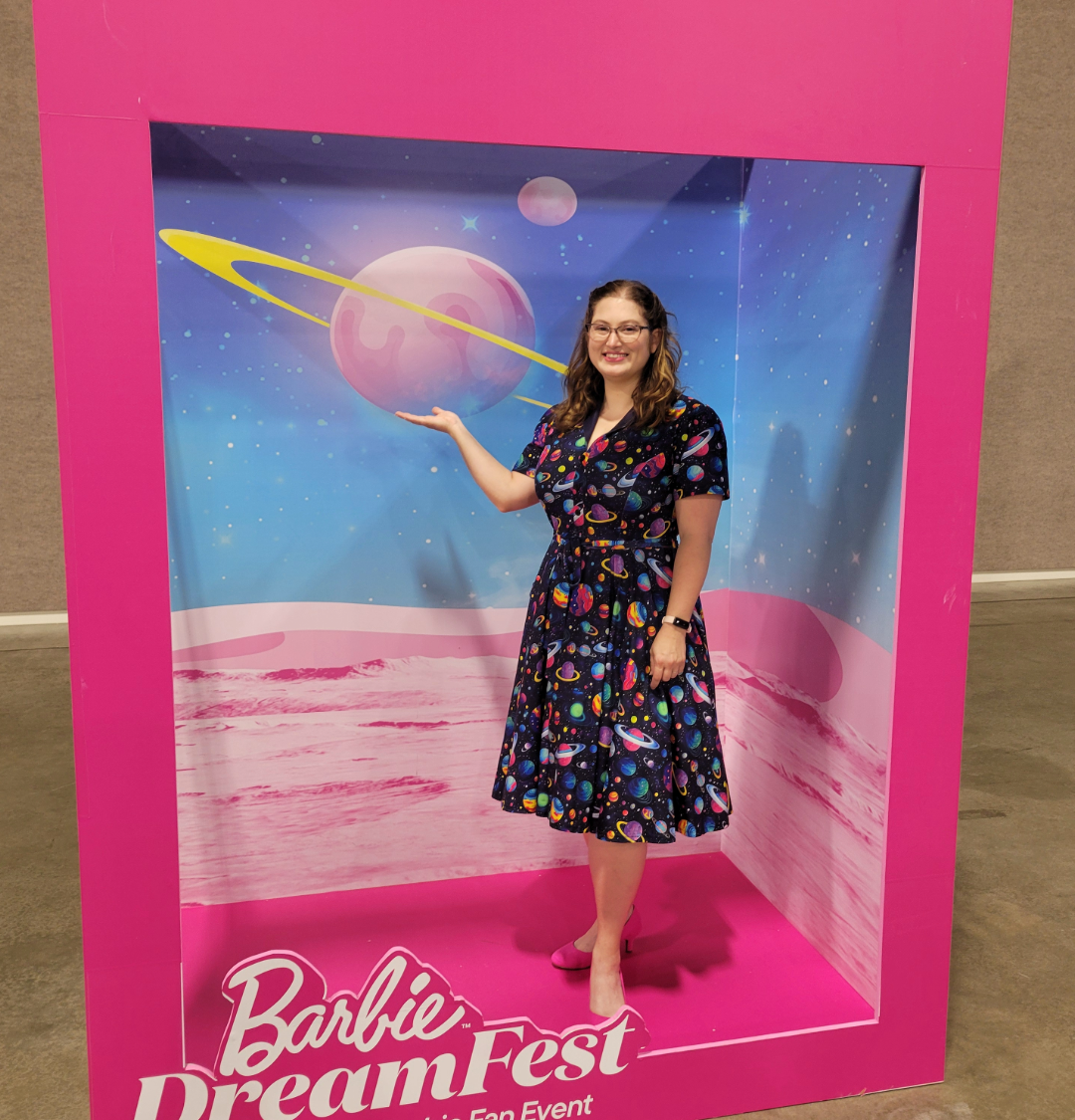
I have a lot of astronaut Barbies. I’m trying to get all of them so I can say I have the greatest astronaut Barbie collection. I do like that they’ve been doing more STEM careers for Barbie. I mean, who doesn’t love Barbie?! She has everything — a house, a car and a man. She doesn’t need a man, but she has one. Barbie is very empowering.
Fonts are a passion of mine, too. I worked at the newspaper as a copy editor while I was an undergrad, and I became a font snob. I’ve actually given a flash talk at NASA events about fonts and proper technical styling and writing.
I like comic books and nerdy things, so I go to comic book conventions with my husband.
Then there’s pangolins. I really like pangolins. Every year on Pangolin Day, I make cookies and put pangolin facts on them, and everyone looks forward to them.