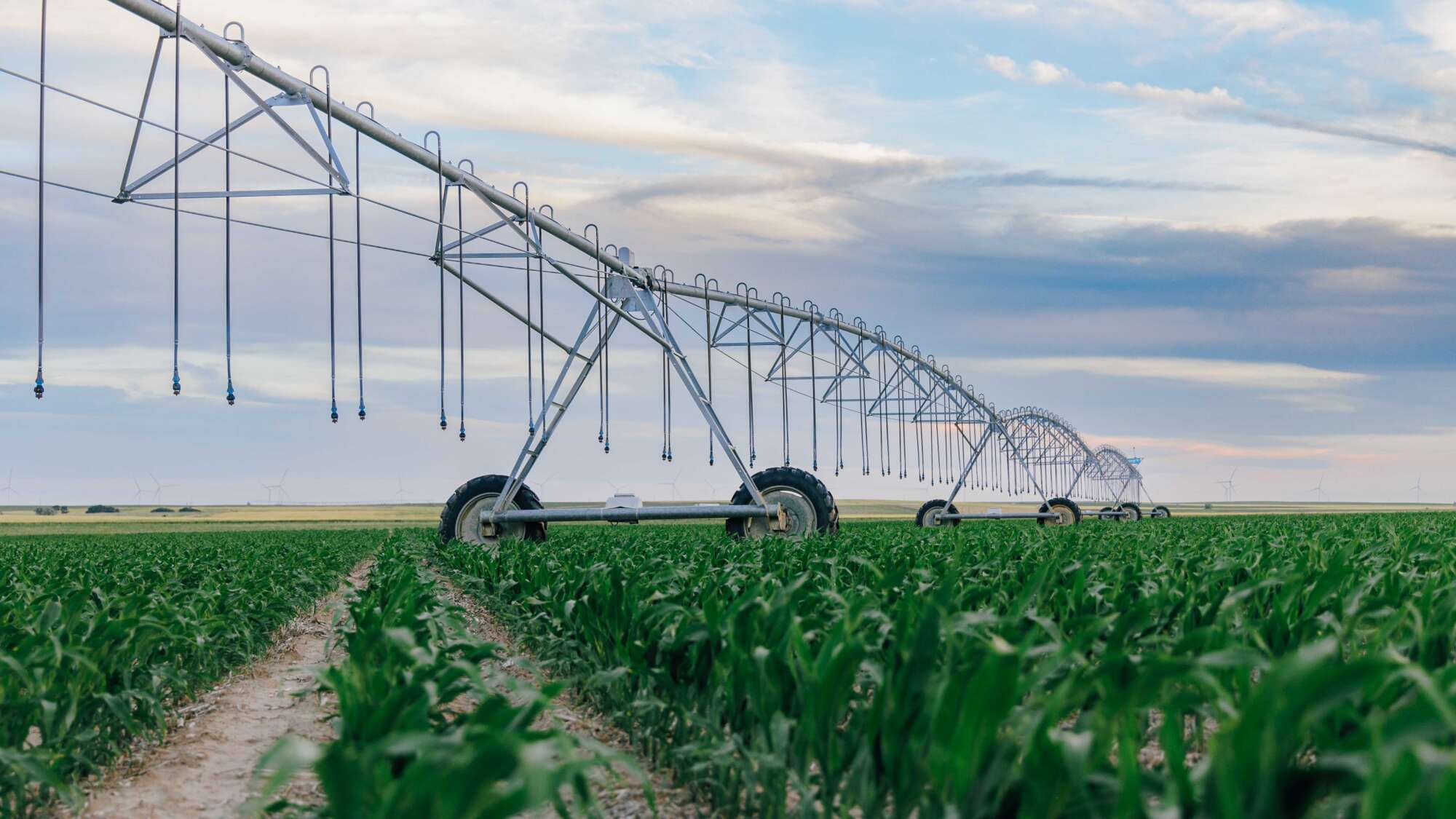
K-State researcher examines a Kansas chloride plume’s risk to irrigated agriculture.
Water in south-central Kansas is in danger. A slowly expanding chloride plume near Burrton, Kansas, is raising concerns about the water quality of Equus Beds aquifer, a vital water source for Wichita communities and industries.
Assistant professor of agricultural economics Micah Cameron-Harp is studying the effects of elevated chloride levels on irrigated agriculture in that area.
What is a chloride plume?
A chloride plume is an expanding body of groundwater with high concentrations of dissolved chloride.
Chloride isn’t inherently damaging and is helpful in most cases. But chloride levels higher than a certain threshold can harm irrigated fields. That’s exactly what Cameron-Harp is trying to prevent through his research.
The initiative
Irrigation is essential to Kansas farms. Irrigated acres account for roughly 30% of crop value. If the plume causes producers to alter irrigation intensity, there could be significant economic ramifications.
“The value of irrigation is clear when we look at land prices — irrigation adds a premium of around $1,450 per acre,” Cameron-Harp said. “Anything that jeopardizes water resources and the ability to grow more water-intensive crops with less risk is critically important for producers to understand.”
To understand the possible consequences of the spreading plume, Cameron-Harp plans to examine irrigation before and after the plume affected an area. To do this, he has been using a plume development model from engineering firm Burns & McDonnell.
K-State collaboration
Cameron-Harp isn’t alone in researching water safety and accessibility. Jeeban Panthi, assistant professor of geology, is using high-resolution geophysical techniques to enhance groundwater models to make more precise plume predictions.
Additionally, the water quality lab at the Kansas Water Institute is supporting research with its advanced instrumentation and trained scientists.
“This work demonstrates K-State’s capability to tackle both the biophysical and behavioral components of problems like the water challenges our state faces,” Cameron-Harp said. “With resources like the new water quality lab, ongoing hydrologic modeling and collaboration across disciplines, we’re gaining a clearer picture of how water systems change and what that means for producers.”
By Kate Ellwood
Curated from From the groundwater up