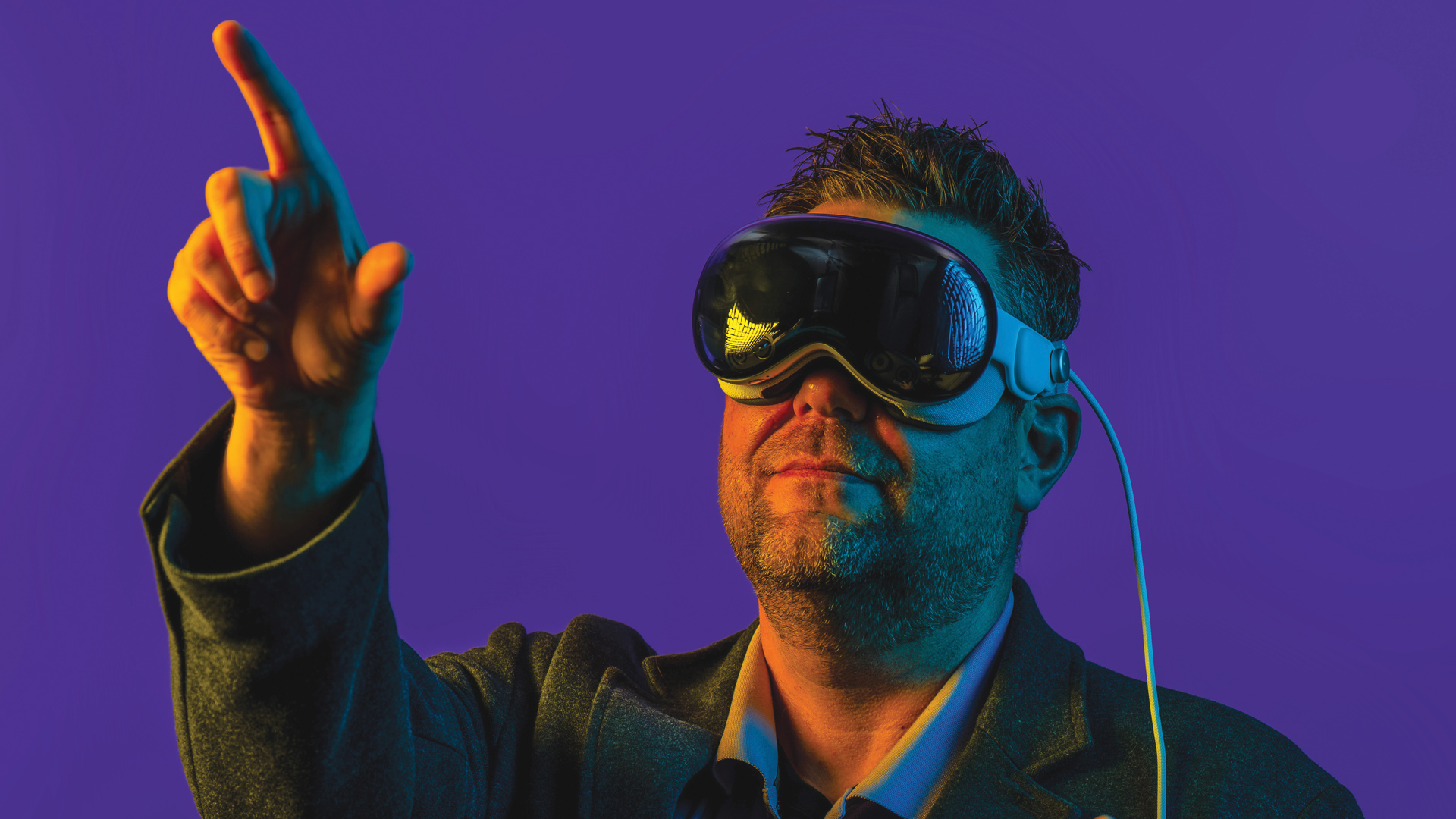
Michael Oetkin
Assistant professor of immersive systems design
Director, K-Aires Center
Can extended reality bring us closer together? K-State’s expert on creating digital worlds just wants technology to fade away.
Hunting for microleaks aboard the space station. Speeding through a haunted forest. Flying through a hurricane.
Thanks to future-forward professor Michael Oetken and his creative students, you can tackle those otherworldly experiences now.
So what new worlds will come next? The digital future’s open wide.
At the forefront
If Oetken’s specialties sound plucked from a far-out sci-fi novel — everything cyber-human systems to extended reality application design — rest assured that he’s also grounded. He’s a national expert on taking emerging technologies like virtual reality, AI and immersive experience and integrating them not only into classrooms, but also into collaborations with industry.
In K-State Salina’s immersive systems design major, Oetken’s students will work alongside Pure Imagination Studios, an award-winning entertainment giant with clients like DreamWorks, FOX and Marvel Entertainment, to create new worlds in gaming, media and interactive experiences. A groundbreaking facility known as K-Aires, scheduled to open later this year, will be a great leap forward for K-State.
“We want to take this degree we’ve built and do something new — where students get unparalleled applied learning,” he said. “They’ll be in a working studio that’s using these technologies every day.”
Oetken and his students have already started creating immersive worlds for the National Oceanic and Atmospheric Administration (training pilots to fly through hurricanes), the Air Force Academy (tracking the interlocking orbits of satellites) and tech manufacturer General Atomics (building digital “twins” of aircraft for virtual maintenance training).
And how’s this for a cool class project? These K-Staters are building a VR simulation for space camp students at the Cosmosphere in Hutchinson, Kansas, that gives campers the feeling of zero gravity on the International Space Station.
“It’s all about the human factor. You get the sensation by the way we design the physics. If we do it wrong, like a badly designed roller-coaster simulation, it can make you sick,” he laughs. “You’ll feel like you’re going to lose it!”
Taking the fiction out of sci-fi
What drives Oetken’s fascination with the future? He says it’s partly generational. He grew up with Nintendo and PlayStation gaming, and his passion for sci-fi films and TV is still strong.
“As the technology gets better, as sensors get smaller, as AI integration improves, life becomes more like Star Trek,” he said. “You can build any world you want.”
Just as Dick Tracy’s radio watch morphed into the Apple watch, the gizmos of yesteryear eventually end up as everyday tools.
“You always saw this stuff in the old sci-fi movies,” he said. “Then when you started to see VR headsets in real life, you thought, ‘Whoa, it’s finally happening.’”
Hope for the future
If you keep up with sci-fi, especially the dystopian type, you may envision a future where computers take over. But can’t these booming technologies transform our lives for the better?
And what would that look like? It might be an amped-up Zoom call that transcends physical space.
“I’d love to get to the point where I’ll have a Zoom call where my mom and I put on our VR glasses” he said. “And all of a sudden, we’re in her living room. There’s the physical presence of us being there together.”
It’s surprising that a futurist like Oetken just wants to see technology fade into the background.
“If it’s done well enough that it’s part of everyday life, you won’t notice the technology,” he said. “That’s where I hope this is going — to make life easier and productive. Then you can focus on the important stuff: the human part.”