AI’s ability to crunch data speeds up research, while K-State scientists strive to figure out how the AI “brain” works.
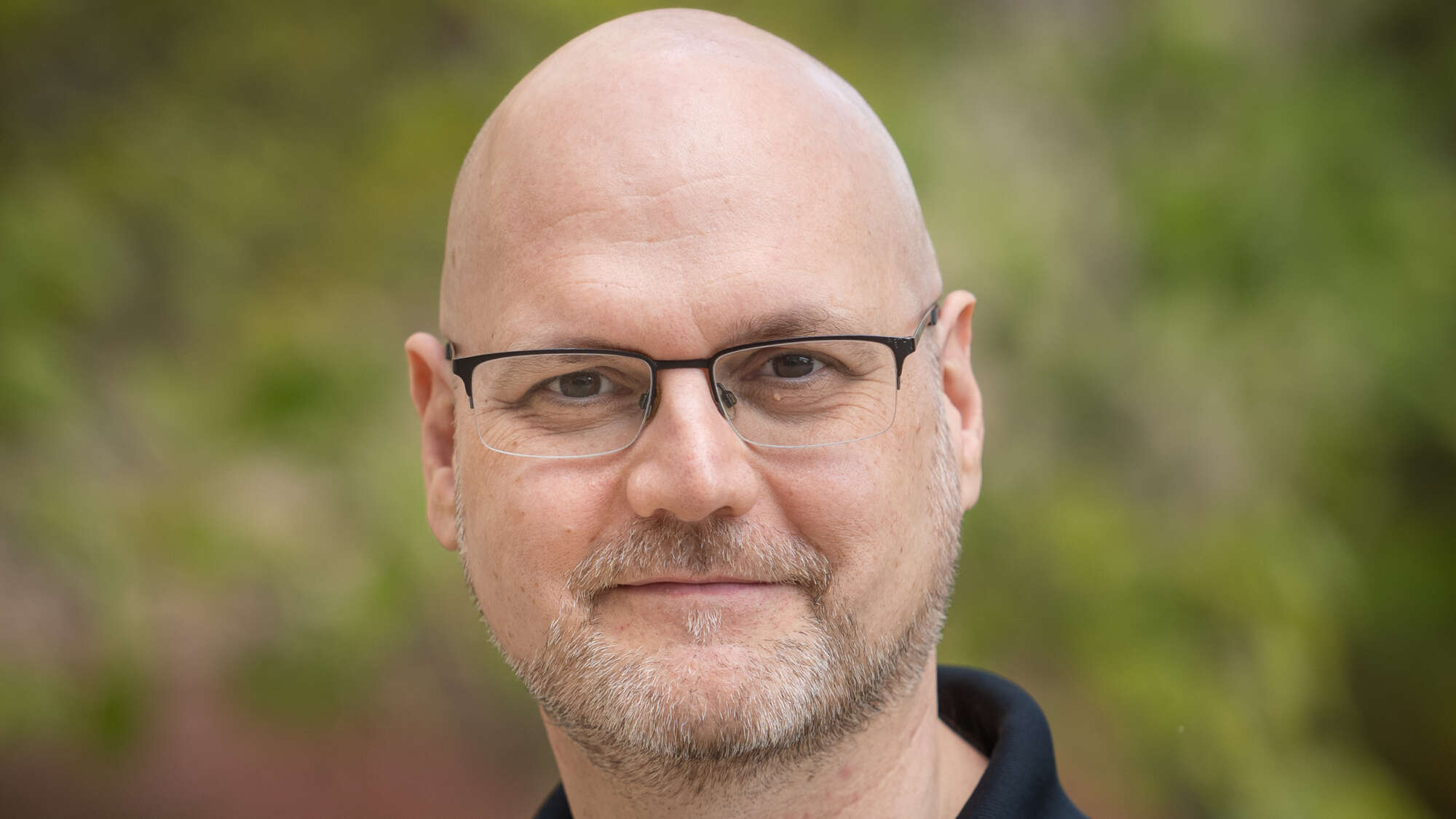
Pascal Hitzler, professor of computer science, is director of the Center for Artificial Intelligence and Data Science. He’s a founding chair of K-State’s AI symposium and the Institute for Digital Agriculture and Advanced Analytics, an initiative that combines artificial intelligence, data science and agricultural research.
What do people not understand about AI?
Most of AI is not generative AI, which includes chatbots and image generators. These are just the tip of the iceberg, but they get a lot of attention because everybody can play around with them.
However, a system like AlphaFold — a predictor for protein folding — has huge impacts in fields where proteins are important. It may have more impact on research than generative AI because of all the foundational changes it brings. But you can’t play around with it, so most people wouldn’t even understand what it’s doing.
What research are you doing to understand AI better?
My research is multifaceted. Some research has to do with making AI more transparent, trustworthy and reliable. I’m working with my colleague Eugene Vasserman in cybersecurity, and we have a couple of patents pending.
One aspect of my research is trying to understand the internal mechanisms of AI systems. We understand what they’re doing mathematically because we’re programming them. However, the information processing is not done in a way that is decipherable to us as humans.
We also don’t understand much about artificial intelligence that is based on machine learning, which is intended to find mathematical and computational solutions. The only thing we can get out of their use is statistical assurances. We train a system and test it on data, and in 95% of the test cases the system performs well. But that still means we often don’t know why it doesn’t perform well on the remaining 5%.
What we’re trying to do is understand what happens inside. What do the neurons do? It’s a little bit like neuroscience. That’s part of the foundational research we’re doing; figuring out what happens inside these systems. What do they actually detect? What do they actually process?
The long-term work of this goes toward understanding what an internal information flow may be in terms that humans can understand. That introspection may help us understand why AI makes mistakes and how to avoid the mistakes. In the end, this makes the AI more accurate, more reliable and more trustworthy.
Our better understanding of the internal workings of these systems helps us detect AI fakes, such as deepfake images. We actually have a patent pending on this idea.
How is AI helping advance your research?
I’m using AI in data integration, a long-term interest of mine.
Data is collected for a specific purpose and is structured in its own way. In order to get to the complex, important questions, you need a lot of data that comes from different sources. Bringing that data together is data integration, and the more data you have and the more varied it is, the more difficult the integration is. As more and more data is collected and shared publicly, we then have the problem of how to use it. What does the data mean?
The exciting piece now is that with AI, there is finally a hope we can address these very complex integration questions in a much better and more efficient way. Data scientists know how to do this, but the problem is it’s a ton of work. You need a group of experts, and the more varied data you have, the more experts you need. So it gets really expensive. The holy grail is, how can you speed this up?
And that is where AI is useful. What would have taken months will now take days or weeks. I’m working on how to use generative AI methods to accelerate data integration without losing quality. That’s the tricky piece. How do you get the model to accelerate the data integration without getting nonsense in the data? Because if you get nonsense in the data, then you will get nonsense analysis.
Since data integration work is older, we’ve done more application work in this area, and I’ve collaborated on several projects. We have work that looks at water contamination and understanding how it spreads.
I have worked with historians on data integration regarding the history of the Atlantic slave trade. This was with Michigan State and it was featured in the Washington Post. We’ve also worked with ocean scientists.
Working with my colleagues Eugene Vasserman and Ajay Sharda, I’m looking at controlling boom movements of large agricultural sprayers. You don’t want the booms to swing too much because they might hit something or damage crops or themselves. Understanding how to better control boom movements can be applied to other cyber-physical systems.
How is K-State preparing people to adapt to a world with AI?
What’s happening regarding computer science jobs is a realignment because of AI. Jobs aren’t going away; they’re just going to look different. The computer science department is switching gears right now to roll out undergrad education to address this.
There is a lot of activity around AI at K-State, and one good thing is the AI consulting service. There is a lot of demand to have guidance around AI use. K-State has recognized that there are information requirements and also policy needs. The solutions are not technological. It’s the human solutions that are needed.
It’s important to understand that there’s a lot of bottom-up activity, there’s top-down activity and there are efforts to bring them together.
Should we believe the recent doomsday reports?
The AI danger is real, but the danger doesn’t come from the AI. The danger comes from the fact that we’re producing something that is a powerful technology. Take a computer virus, for example. Computer viruses are autonomous, but nobody would say they’re intelligent. They’re programmed to exploit weaknesses, to spread on the internet and wreak havoc. Now, if you let an LLM go out there and break out of the internet, you have a very powerful computer virus. And the way to control them is not with more technology. It’s with policy.
The danger is the human, not the AI. The real danger depends on what we do with it, not what the AI can do.