AI has the power to bring people together, but it also can widen rifts. Raelynne Hale makes sure K-State has a prominent voice in the conversation.

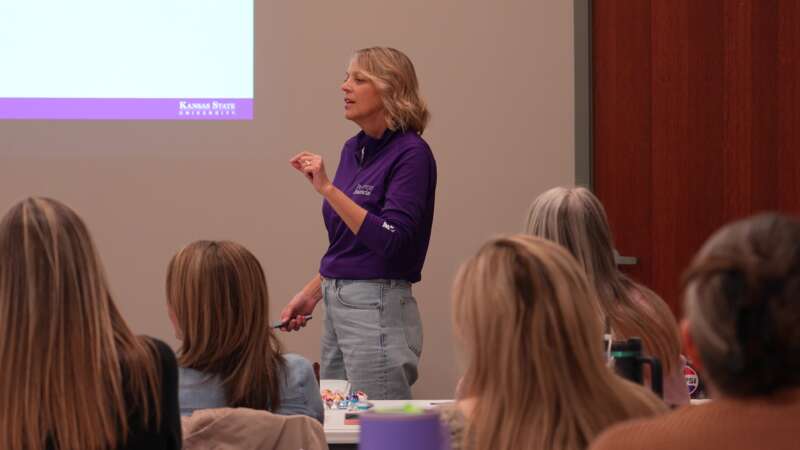
Raelynne Hale, assistant professor of Spanish, researches the relationship between literature and the environment. She’s the founder and director of the Heartland AI Symposium, hosted by K-State. As a language educator and literary scholar, she is fascinated by this new technology.
What sparked your interest in artificial intelligence and how did that lead to founding K-State’s AI symposium?
I’m a literary scholar and really interested in language and creative writing. When ChatGPT came out and could start communicating — albeit with cheesy, horrible, bad poetry and writing — it was fascinating. From a language scholar perspective, I wanted to be a part of that conversation.
I had a discussion with my department chair about bringing in a couple of guest speakers, and that led to discussions with K-State librarians Alice Anderson, Jason Coleman and Carol Sevin, and Pascal Hitzler in computer science. We expanded my idea and ended up creating a three-day symposium about AI. That first year was a happy accident. We never intended to put together a symposium, but a lot of people were excited and wanted to present. We had more than 450 registrations that first year!
Now we have 80 concurrent sessions (60 in person and 20 online) and four keynote speakers, as well as two multi-institutional panels — one with students and one with faculty and academics. We have 11 hands-on workshops, an AI hackathon and a career fair. We also have five university partners: University of Nebraska’s system, University of Kansas and its medical center, Wichita State and University of Missouri.
Locally we partner with the Manhattan Public Library for our community town hall. That’s my absolute favorite event because you don’t know what’s going to happen. People ask a lot of questions, which is really fun.
As a professor, how do you really feel about AI?
I approach it with curiosity. As a language and literary scholar, there’s always the question of ethics concerning where the data AI is trained on comes from. People produced that writing, and it’s not always ethically obtained. I also have concerns about the lack of representation and of other languages.
As founder of the AI symposium, I prefer to stay neutral because I don’t know if there’s a right or wrong answer. I think there’s potential for positive applications, particularly in healthcare and agriculture, and I think there are some big risks and challenges that we need to think about.
What are some of your concerns?
The data AI is being trained on here is very English-centric and U.S.-centric. There’s a lot of loss when we flatten things.
I have a graduate research assistant who is looking at linguistic biases in LLM systems (large language models) and what that looks like. For example, AI translators do okay in Spanish, but it’s still coming from a U.S. or an English-based data set. Sometimes it will produce things that are mixtures of different cultural phrases or expressions from different areas but put them all together in one.
Microsoft Word had that problem in the very beginning, but they took a different approach. They did a lot of open-sourcing and invited communities to contribute to the creation of its early spellcheck and editing software. So the Maori people, for example, came together to help program and develop their language into the system.
I also think a lot about indigenous communities and the environment. My research is in environmental literature and how the environment relates to the stories we tell around technology, how it impacts the physical places and also our own stories and communities. And with AI, I think about the technological impact on our environment as well.
What possibilities does AI open up for people?
I do think there are a lot of really cool applications. We have students who take our classes to learn a language for themselves so they can communicate when they travel. That’s wonderful, and I don’t think we’re ever going to not have that. People who want to communicate with others and learn about others will always do that.
But I think there’s a group of people who maybe aren’t very language savvy or don’t have the time to learn a language. I think these AI systems have opened up an opportunity for them to travel. If that opens a door to experiencing other cultures and meeting other people, and they can do that with an app and an internet connection, that’s beautiful.
I think technology should bring people together. If we’re going to use it, let’s use it for a good reason and to foster human connection.
Will AI replace human translators?
For now, I don’t think so.
Companies don’t want to be liable. The medical field is a good example. There are some translation services online for medical translation, when a doctor and patient don’t speak the same language. The hospitals might not want to pick those up, because who’s liable if there’s a discrepancy? So, for now, there is a preference for human translators because they know the actual context and have knowledge of both the health system and the languages.
The United Nations is another example. It’s multi-country and multi-language, and one misinterpretation could really impact global politics. That’s too risky. Same with the judicial system.
Who knows what will happen five or 10 years down the road? There’s still a huge value in the humanities in general and in language learning; getting that cultural competency, the connection with humans. In K-State’s language department, the motto is “The world belongs at K-State. K-State belongs in the world, and the world is multilingual and multicultural.” I think about that a lot in terms of AI; who has access, how we relate to one another and what is inherently human.
We need a lot more input and representation in terms of global communities, global languages and people’s histories before we can hope for anything better.
Do students actually want AI in the classroom?
Most of my students really hate it. I don’t know if that’s because I’m in the humanities and environmental studies, but I would say most of my students really dislike it. I do have some students who are interested in collaborating with technology, but the general feeling is that most don’t want to.
In my class, we focus on AI literacy, and we have conversations about it. I provide them with facts directly from Open AI and other research bases: how much energy it uses, electricity, water. We talk about the pitfalls, benefits, trade-offs, cognitive benefits and also the cognitive offloading. We have those conversations. Then we talk about whether or not we want to be using it in the classroom.
My students want to learn. They’re curious. So most of them say, “I don’t want to use it at all. I’m here because I want to learn to write for myself, speak for myself, and I want to do the research myself.”
I promise them I won’t use AI to grade their work. I tell them, “That’s your work and creative property. I promise not to put it in AI.”
I would say my students’ biggest fear is being falsely accused of using AI when they’ve put a lot of effort into something. There’s this interesting fear of being great now, and I find that fascinating and really disheartening.
The students do acknowledge that they feel pressure to at least be aware of AI and know how to use it. So we discuss what things AI can do and what it struggles with. I think that’s what they’re going to have to navigate in the workplace and out in the world. I believe in Horvath’s idea that you can teach a tool, but then students only know how to use that tool. And when the tool changes every few years, that is problematic. Instead, students need to know how to think, evaluate tools and decide for themselves when they want to use a tool or not.
What do you think students need to know when it comes to a world with AI?
Information literacy is even more crucial now. As I work with students, especially the younger ones, sometimes they have a hard time differentiating between an opinion blog post and an academic article. Can they identify who published it, who funded it, who wrote it? All of those basic digital literacy skills are so much more valuable now. And if they are using AI, they need to be aware that it can be wrong, but it may present information as correct. AI literacy doesn’t just mean knowing how to use a tool but also how to think critically about these different tools and technologies and understand what they can and can’t do. I think that is the most important thing we can offer anyone, students and beyond.