If these limestone walls could talk …
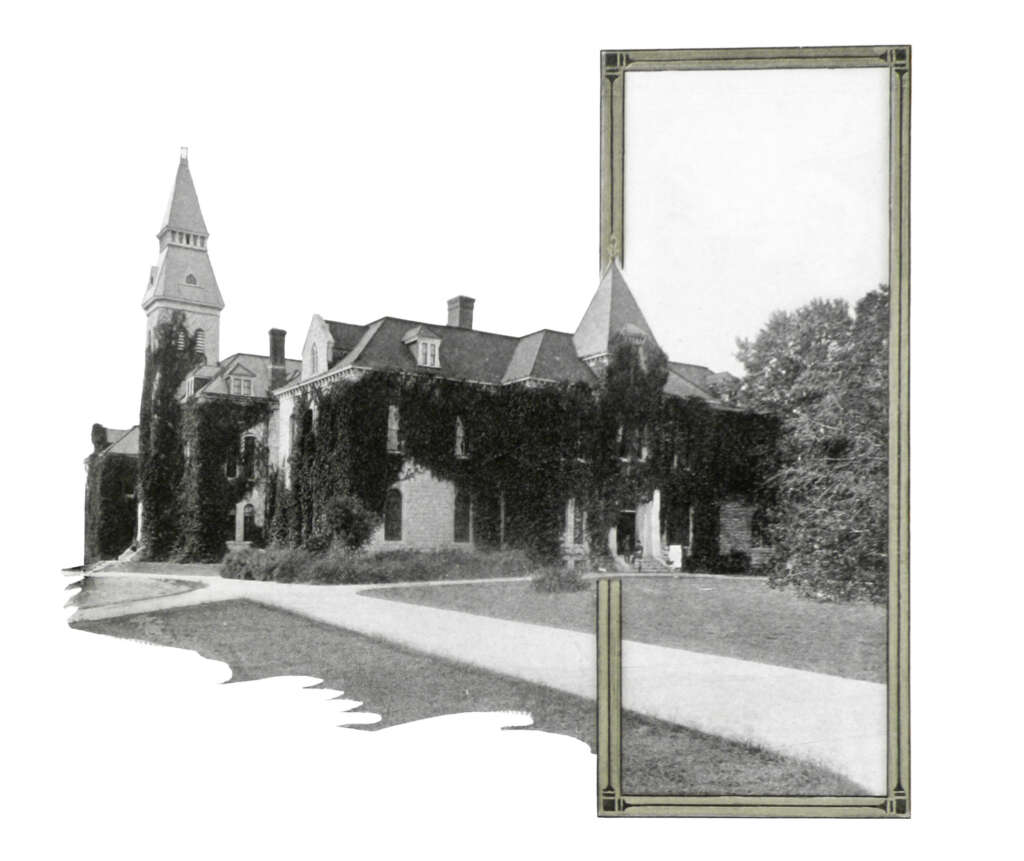
There’s so much about Anderson Hall you don’t know. Easily Kansas State University’s most recognizable campus symbol, it’s the site of many memorable moments throughout our history, including student demonstrations, class pranks, natural disasters and even the occasional skunk visit.
It’s also seen a dizzying number of transformations. If you were a student in 1920, say, you could come to Anderson for class and stay for a trim at the barbershop or a bite to eat at the “campus canteen.”
Anderson has always risen to the challenge of becoming whatever K-State needs. Now, in 2026, it’s at risk of becoming a memory. A restoration project is in the works — a seize-the-moment chance for K-State to save Anderson Hall.
Much has been written about this longstanding icon, but a deep dive into its storied history reveals some lesser-known-yet-intriguing reasons to love the legendary Anderson Hall.
It proved patience is a virtue.
First known as the Practical Agriculture Building and later the “main college building,” this stately structure was built for an estimated $79,000. The architect, Erasmus T. Carr of Leavenworth, Kansas, designed Anderson Hall to evolve in three phases.
- First came the north wing in 1879. The state legislature appropriated $12,500 for its completion.
- The central section was constructed in 1882. The Kansas Board of Regents requested an appropriation of $30,000 for the project, which was delivered under budget by $40. According to the KSAC Industrialist in 1883, Anderson was “regarded as peculiarly neat and commodious, at a moderate cost.”
- The south wing followed in 1884 after receipt of another $20,000 from the state. This time the cost of carpentry and masonry went over budget by $1,300.
It’s not old, it’s historic.
The hall was named after Kansas State Agricultural College president John Alexander Anderson in 1902. Anderson (the man) was the second president of the college from 1873-1879, and Anderson (the building) was the sixth structure on the current K-State campus.
In 1980, it was added to the National Register of Historic Places.
Because it’s always been a looker.
With Victorian high-gothic lines and classic Kansas limestone, this building was stylish from the start. While Anderson looks mostly the same from the outside, inside it has housed a perpetual parade of spaces: library, chapel, dental office, gym for calisthenics, classrooms, cubicle-stuffed offices and more. So what was it like in its early days?
- The front hall had two stairways to the second floor, over which stood a “stained-glass skylight” that gave the appearance of a dome.
- The chapel space could seat 600 people in perforated wood and iron “opera chairs.” The ceiling was 30 feet high, and the room was lit by a central “reflector with 30 double gas jets.”
- The library, about 30 feet by 30 feet and lined with walnut and pine shelves, held almost 5,000 books — with ag and horticulture boasting the biggest sections. The adjacent reading room was adorned with giant maps of Kansas and the nation.
- The south wing housed a model kitchen and dairy in the basement. On the first floor was a sewing room and the “lady superintendent’s” office.
It wouldn’t let the music die.
The first bell in Anderson Hall was a gift from philanthropist Joseph Ingalls Esq. It was delivered — all 513 pounds of it — by wagon to Manhattan in 1861 after a train ride from Massachusetts to Atchison, Kansas. The bell serenaded students from two other buildings before being moved into Anderson Hall’s tower in 1882.
It was rung by hand until an electrically operated carillon was installed in 1965, except for a brief period in 1905 when the clapper was stolen, leading the yearbook staff to name that year’s edition “The Bell Clapper.”
Today you can visit the original bell just outside Bluemont Hall.

The clapper from the original bell was stolen in 1905 to serve as a class memento. Today it can only be seen in the library archives.
It’s more mysterious than both “National Treasure” movies.
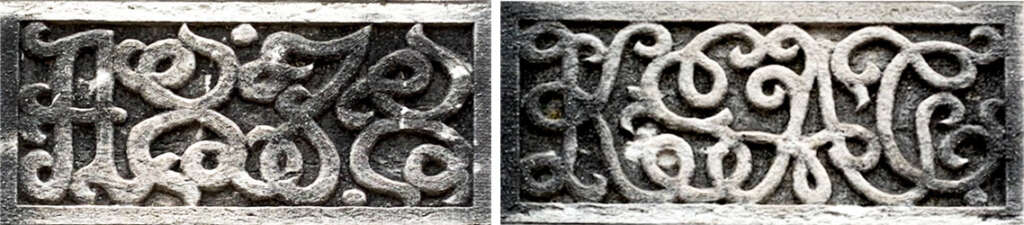
It takes more than an amateur cryptologist to decipher the stone carvings at Anderson’s north entrance. What looks like, at first glance, Victorian-era curlicues actually reveals something notable about our beloved college.
Can you crack the code?
It’s the perfect place to speak out.
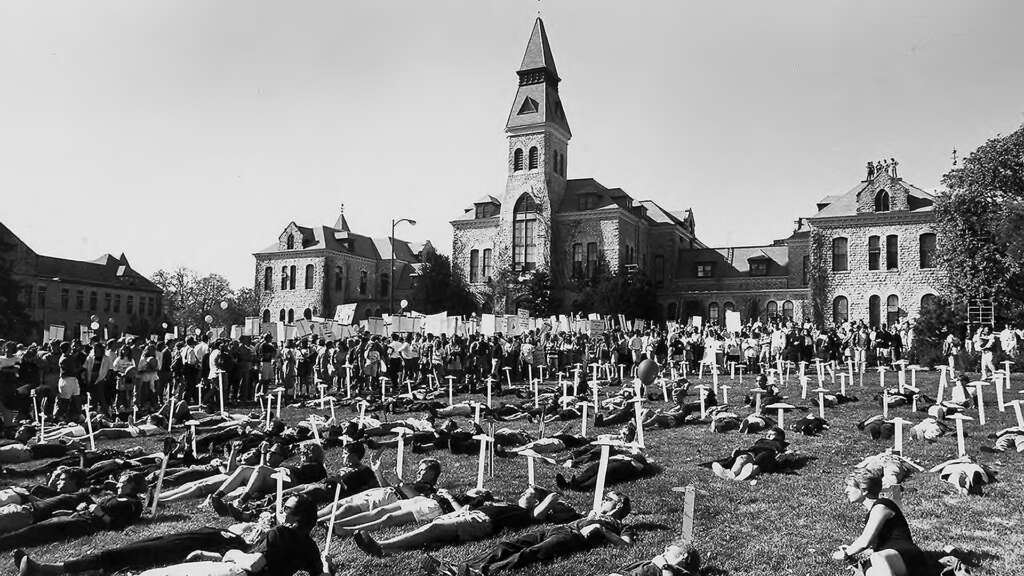
With a central location that also happens to house the offices of the university’s top brass, Anderson proved a popular place to gather over unpopular university developments.
1973: When booming enrollment left 1,000 students without living quarters, a large encampment appeared on the Anderson lawn to demand solutions.
1979: 1,000 students halted President Duane Acker’s plans to demolish Nichols Hall and replace it with landscaping and a driveway to McCain Auditorium.
1991: White T-squares made to resemble grave markers peppered the Anderson lawn when approximately 1,500 protested President Jon Wefald’s proposal to dissolve the College of Architecture and Design and the College of Human Ecology (now Health and Human Sciences) as part of a reorganizing effort.
Because it’s bringing back the porches.
A rocking chair and a glass of lemonade, anyone?
From 1884 to 1945, wooden porches graced the front of Anderson between the center section and the north and south wings. The porches were enclosed with the help of German POWs to create more office space, but will make a comeback with this restoration.
Because, above all else, it’s a survivor.
As campus buildings go, this one is tough as hell.
Over the years, Anderson fended off near-biblical pest invasions: bee swarms, resident skunk and raccoon families, occasional bats that made a habit of hanging out (and not just in the belfry). In the 1990s, bats swooped into the admissions office — spooking visitors but adding oomph to the typical campus tour.
Most serious of all: An overnight lightning strike in 1993 zapped the south tower’s copper spire. The spire, ornamented with a crown and stars, was described by the Collegian as looking “as if it had been a tinfoil Christmas star.”
Even worse, the lightning set the building on fire. If not for observant art major Craig Goodman speed-dialing the fire department, Anderson might have wound up a charred relic. Goodman was honored with a plaque and campus celebration that year, but everyone knows he deserved nothing short of a full-ride scholarship.
It’s always up for a laugh.
Anderson served as a prankster’s paradise for the ages. That mid-’80s trash can perched atop the flagpole seems lame compared to the tricks of earlier classes.
- After planting an ivy vine that eventually covered Anderson Hall, a class of 1892 senior presented the trusty spade he used to the next class. This symbol of K-State ideals lived in a glass case inside Anderson — until it was stolen by the next class. The tradition of passing the spade (or nabbing it) lasted through 1895.
- Horticulture-major hoodlums in the class of 1910 planted wheat on the main lawn to form a “10.” Sadly, a pre-harvest mowing spoiled the punchline.
- In 1898, a brass shepherd’s crook was fashioned to symbolize how seniors “shepherd” younger students. Each class would add bright ribbons embroidered with their year. Like the spade, the crook was repeatedly robbed and recovered by various classes. It was kept in Anderson Hall until the class of 1901 relocated it for safekeeping. Over the next decade it hid in cellars, trunks, attics and even under a nearby bridge.
It’s never been your basic building.
It’s not that complicated, is it?
In a word, yes. This renovation project has top-to-bottom challenges to address. And because of its status as one of the nation’s official historical markers, certain rules and restrictions apply.
Windows
All 268 of them in differing shapes and sizes must be replaced with custom materials. These aren’t things you can get off the rack at Lowe’s! The existing rotting wood window frames will be modernized with thermally efficient, maintenance-free aluminum versions. It took some early planning and collaboration with the State Historic Preservation Office, but the original 1800s window profiles can be recreated within 1/16 inch.
Roof
Anderson got a new roof in 2012, but its copper gutters and fascia must be replaced to effectively redirect water away from the building.
Woodwork
Deteriorating eaves and wooden trim are allowing water and wildlife to find their way in. By replacing this original exterior woodwork with stamped metal, we’ll have a decorative feature that lasts significantly longer while staying within approved historical parameters.
Stonework and masonry
It’s shifting and cracked, resulting in safety concerns. The mortar will be restored around the entire building, decorative stone will be replaced in keeping with the original design, and modern stone windowsills that direct water away from the building will be incorporated to keep moisture outside where it belongs.
Entry walk-ups
Currently, Anderson’s only ADA-accessible entrance is via the basement. This project will update the main entrance to become ADA-compliant and replace crumbling stone while maintaining the building’s architectural character. The other entries will also be updated.
Foundation stabilization
A must, if we want to safeguard Anderson’s future. Waterproofing below grade will create a watertight and significantly more efficient building envelope.
Show some love
The building is in an advanced state of deterioration, but there’s a golden opportunity — if we act by June 2027.
- If the K-State community will pitch in $24.4 million, we’ll unlock matching state funds through the 2024 Campus Restoration Act and secure a $42 million renovation at nearly half the cost.
- The work would also qualify for historical tax credits, which can be reinvested into Anderson for interior improvements.
- And this time, there’s a sustainability fund that protects this important landmark for the long haul.
We can’t afford to wait
It will take Wildcats everywhere and gifts of all sizes to restore Anderson to its former glory.
How can you help preserve a piece of K-State history?
Contact the KSU Foundation digital development team
785-775-2400 or giving@ksufoundation.org
Or donate online: ksufoundation.org/gfks/anderson